

The Heron Prince is one of the quieter cards in The Black Bird Oracle, and perhaps that’s what makes it so interesting.
Deborah Harkness associates it with awareness, solitude, and self-possession. The guidebook makes an important distinction between being alone and being lonely, suggesting that solitude can provide an opportunity to understand ourselves without the expectations and demands of other people.
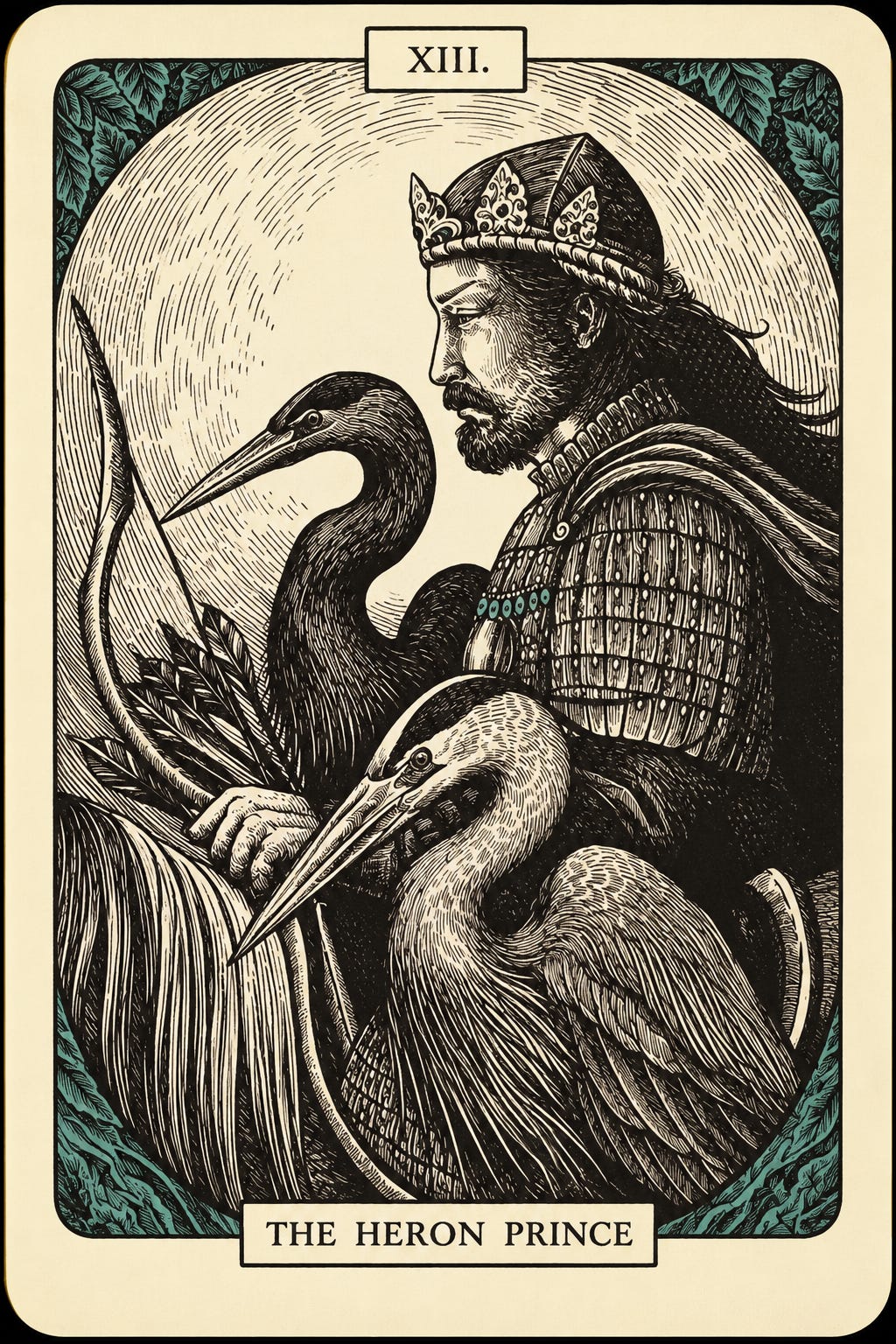
That made me think about how rarely the characters in All Souls are truly alone.
They belong to enormous families, covens, political institutions, scientific communities, and networks of relationships that stretch across centuries. Even when they are physically separated from others, they carry obligations, memories, and loyalties that continue to shape their decisions.
So who among them actually knows how to be alone?
Gallowglass might seem like an obvious answer.
He is capable of extraordinary independence. He travels, observes, protects, and frequently operates at a distance from the family whose interests he serves. His long life has given him the ability to move through different places and periods without needing the reassurance of a permanent home.
But Gallowglass also demonstrates that independence and emotional freedom aren’t necessarily the same thing.
His loyalty to Philippe, Matthew, and Diana shapes so much of his existence that it becomes difficult to imagine who he might be without those responsibilities. He can be physically alone for long periods, yet his choices remain connected to people whose needs and happiness often take precedence over his own.
That raises a question I find particularly interesting: Can someone be genuinely independent when so much of their identity comes from being needed?
Ysabeau approaches solitude differently.
After Philippe’s death, she continues to live within the world they created together. Sept-Tours remains a place of family history and continuity, but it is also a reminder of the person whose absence changed her life.
Ysabeau knows how to live without Philippe physically present. She has survived long enough to understand that grief doesn’t simply disappear because time passes, and she has learned to maintain relationships, responsibilities, and interests of her own.
Yet there is a difference between learning to live without someone and no longer feeling their absence.
Her solitude contains both strength and memory, and perhaps that is why she can appear so self-possessed while remaining deeply attached to the past.
Then there is Hamish Osborne.

Hamish is particularly interesting because he moves between worlds without appearing to need complete belonging in any one of them. He is a daemon with a successful professional life, close relationships with powerful people, and a perspective that often allows him to see situations more clearly than those directly involved.
His friendship with Matthew is important, but Hamish doesn’t seem to define himself entirely through that relationship. He can offer advice, challenge assumptions, and remain outside the emotional intensity that frequently surrounds the de Clermont family.
In a world where loyalty often becomes entangled with obligation, Hamish demonstrates the value of maintaining a separate perspective.
And then there is Diana.
When we first meet her, Diana has constructed a life that appears remarkably independent. She is a respected scholar, comfortable working alone in libraries and archives, and determined to define herself through her academic accomplishments rather than her magical inheritance.
But her independence is also partly an escape.
By distancing herself from magic, Diana has created boundaries that allow her to avoid questions about her family, her childhood, and the parts of herself she finds difficult to understand.
Her relationship with Matthew changes those boundaries, but it also challenges her understanding of what independence means. She must learn that accepting love and support doesn’t require surrendering her identity.
That may be the most important distinction The Heron Prince brings to these characters.
Gallowglass can be alone without being free of obligation. Ysabeau can be self-sufficient while continuing to grieve. Hamish can maintain independence without withdrawing from meaningful relationships. Diana can discover that belonging to a family doesn’t mean losing herself.
Perhaps solitude isn’t really about how much time we spend apart from other people.
It’s about whether we know who we are when their expectations, needs, and opinions are no longer directing our choices.
And in All Souls, where family and loyalty shape almost every major decision, that may be a rarer quality than any magical ability.
Your Draw
Which character in All Souls do you think is most comfortable being alone—and which one would struggle the most if nobody needed them?