

The Wheel is one of those cards in The Black Bird Oracle that seems particularly appropriate for a world inhabited by creatures who can live for centuries.
Deborah Harkness associates it with change, volatility, and the cycle of life. The Wheel reminds us that nothing remains exactly as it is, no matter how much we might wish otherwise. Circumstances change, relationships evolve, and even the most carefully constructed lives eventually encounter something unexpected.
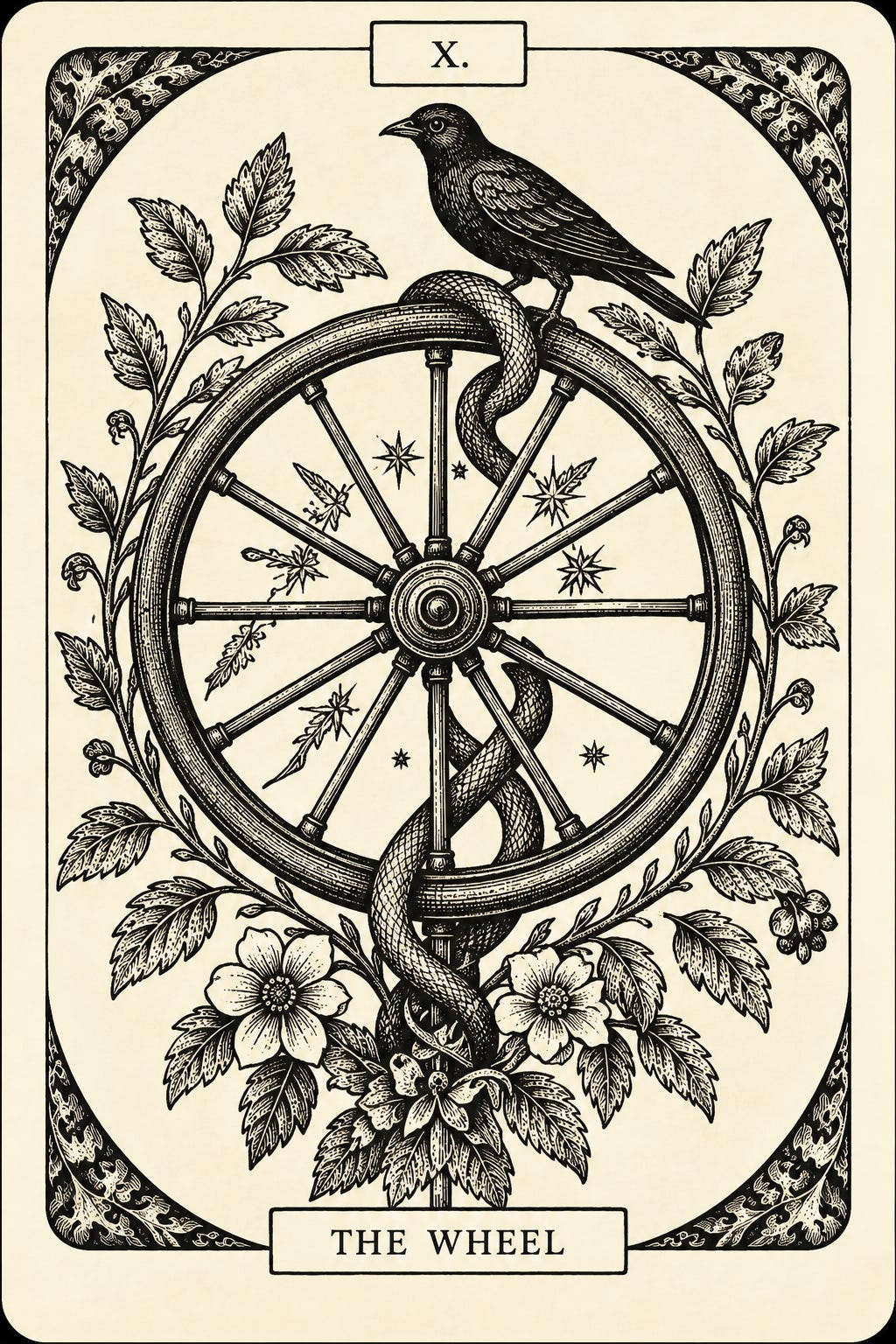
That made me think about a peculiar contradiction in All Souls. Some of the characters who have lived the longest seem to have the hardest time accepting change.
Ysabeau is an interesting example.
She has survived wars, political upheavals, the rise and fall of kingdoms, and extraordinary transformations in the human world. She has watched entire generations disappear while her own life continued. By any reasonable measure, Ysabeau should be exceptionally comfortable with change.
Yet her attachment to the past is one of her defining characteristics.
Sept-Tours is more than a home. It is a place where centuries of family history remain present, where Philippe’s influence continues to be felt, and where Ysabeau maintains traditions that connect the family to the world they once knew.
Her initial reaction to Diana also reveals how difficult change can be when it challenges something more personal than politics or technology. Ysabeau has lived through enormous historical transformations, but accepting a witch into her family requires her to reconsider beliefs shaped by centuries of conflict.
And perhaps that is the distinction The Wheel makes visible. Surviving change isn’t necessarily the same as welcoming it.
Baldwin approaches change from another direction.
As head of the de Clermont family, he has a responsibility to preserve an institution that existed long before many of its current members were born. He understands that stability requires rules, and that decisions made by one family member can have consequences for everyone else.
But Baldwin’s instinct to protect the family sometimes makes him resistant to the very changes that might help it survive.
His challenge isn’t simply learning to accept new circumstances. It’s recognizing that maintaining Philippe’s legacy may require doing things Philippe never had to do.
Marcus offers an almost perfect contrast.
He belongs to the same ancient family, yet he repeatedly demonstrates a willingness to question its assumptions. His experiences during the American Revolution and his efforts to build a different kind of family suggest that he understands something Baldwin sometimes struggles to accept: traditions can provide continuity without requiring every generation to live exactly as the previous one did.
Marcus doesn’t always make the right decisions. His history includes painful failures and consequences that extend far beyond his original intentions. But he is willing to imagine that the future might be different from the past.
And then there is Sarah.
Sarah has never needed centuries to become attached to the life she knows. Her home with Emily, her magical practices, her family relationships, and her understanding of what it means to be a Bishop provide a familiar structure for her world.
When that world changes, Sarah has to confront losses and uncertainties that cannot be resolved simply by returning to the way things were.
Her story reminds us that change isn’t always something we choose. Sometimes it arrives without warning and demands that we find a way to continue.
What interests me about The Wheel is that it doesn’t distinguish between welcome and unwelcome change. The world keeps moving regardless of whether we feel prepared.

Ysabeau can preserve Philippe’s memory without preserving every assumption he held. Baldwin can protect the family without preventing it from evolving. Marcus can embrace new possibilities while acknowledging the consequences of his past. Sarah can carry love and memory into a future that looks very different from the one she expected.
Perhaps the characters who survive change most successfully aren’t the ones who resist it or even the ones who welcome it.
They’re the ones who eventually understand that continuity doesn’t require everything to remain the same.
And in a world filled with immortals, that may be one of the hardest lessons of all.
Your Draw
Which character in All Souls do you think has changed their beliefs the most over time—and which one is still holding on to a past they need to release?