

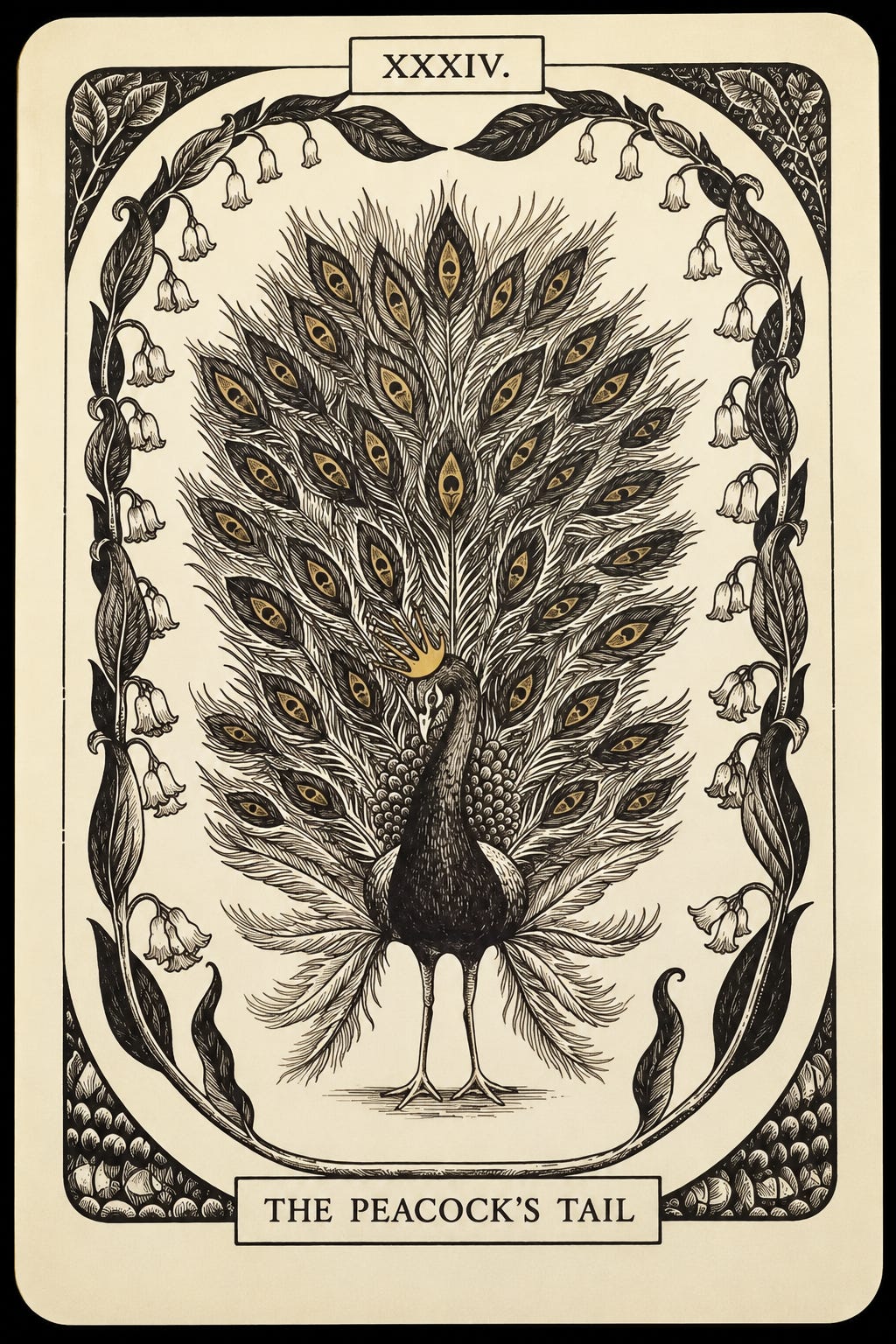
The Peacock’s Tail is one of the more intriguing alchemical cards in The Black Bird Oracle, particularly because its meaning isn’t entirely positive.
Deborah Harkness associates it with reaching a goal, attaining glory, and vanity. In the alchemical tradition, the peacock’s brilliant colors mark an important stage of transformation, but they also remind us that change can be dazzling without necessarily being complete.

That distinction made me think about the characters in All Souls who undergo extraordinary transformations. Some choose to change. Others have change forced upon them. And some discover that becoming the person they wanted to be comes with consequences they never anticipated.
Phoebe is an obvious place to begin, but perhaps not for the reason we might expect.
When we first meet Phoebe, she is already a capable, independent woman with a successful career and a clear sense of who she is. Her relationship with Marcus introduces her to the de Clermont family, but she doesn’t immediately abandon her own identity to become part of his world.
Her decision to become a vampire is therefore particularly interesting. Phoebe isn’t escaping a life she dislikes. She is choosing to leave behind a life that has meaning, relationships, and possibilities of its own.
And unlike Marcus, who becomes a vampire under circumstances he could never have anticipated, Phoebe has time to consider what her transformation will require.
She knows that she will have to surrender aspects of her human life, accept a new relationship with time, and learn to exist within a family whose traditions stretch back centuries. What she cannot know is precisely how becoming a vampire will change her understanding of herself.
That makes her transformation both courageous and complicated. She gains the possibility of a future with Marcus, but that future requires giving up another one.
Jack’s transformation is almost the opposite.
Jack never has the luxury of planning the life he will become. As a child in Elizabethan London, he finds something resembling a family with Diana and Matthew, only to lose them when they return to their own time. His subsequent experiences leave him carrying wounds that extend across centuries.
By the time Jack reappears, he is almost unrecognizable from the boy readers first encountered.
Yet the most interesting part of Jack’s story isn’t simply how much he has changed. It’s whether he can separate the person he has become from the things that happened to him.
His reunion with Matthew and Diana doesn’t erase his past, but it gives him an opportunity to imagine a future that isn’t entirely defined by it. Jack cannot return to the child he was. He can only decide what kind of person he wants to become next.
Matthew presents a different kind of transformation.
He has spent centuries living with the consequences of blood rage, violence, guilt, and obligations to the de Clermont family. His relationship with Diana challenges assumptions he has held about himself for a very long time.
But Matthew’s transformation is less dramatic than Phoebe’s or Jack’s. He doesn’t become another species or acquire a new set of extraordinary abilities. Instead, he gradually has to reconsider the identity he has built around being dangerous, responsible, and frequently unworthy of the happiness he wants.
That may be one of the hardest transformations in the series because it requires him to change without being able to leave his history behind.
And then there is Satu.
Satu is a reminder that transformation isn’t automatically a story of growth or redemption. Her extraordinary abilities and determination to understand her powers could have led her toward greater wisdom. Instead, her ambition repeatedly brings her into conflict with other witches, particularly Diana.
What makes Satu interesting is that she doesn’t lack the potential to become something remarkable. She struggles with what she believes that potential entitles her to do.
The Peacock’s Tail seems especially appropriate here because its beauty is inseparable from the possibility of vanity. Becoming more powerful, more knowledgeable, or more accomplished doesn’t necessarily mean becoming wiser.
That may be the most interesting distinction among these four characters.
Phoebe chooses transformation because she wants to build a future. Jack struggles to reclaim a future after others have shaped so much of his life. Matthew learns that changing how he understands himself may be as difficult as changing his circumstances. Satu demonstrates what can happen when the pursuit of power becomes more important than the responsibility that accompanies it.
All four change, but not all change in the same direction.
Perhaps that’s what The Peacock’s Tail makes me notice most about All Souls. Deborah Harkness rarely presents transformation as a simple movement from one state to something better. Every change carries something forward, and every new possibility comes with something that must be reconsidered or left behind.
The question isn’t simply who becomes the most extraordinary person.
It’s who becomes someone they can live with—and whether the price of getting there was worth paying.
Your Draw
Which character in All Souls do you think has changed the most, and do you believe the person they became was worth what they had to give up?