

Experience The Black Bird Oracle Special Series in a new way. Click the READ IN APP button to open this article, then tap Listen to hear this article’s audio companion - perfect for when you’d rather listen than read. Because sometimes, the words we need are meant to be heard.
The Key is one of those cards in The Black Bird Oracle that seems simple until you consider that it can do two completely opposite things.
Deborah Harkness gives it three ideas: unlocking, locking, and foundations. A key can give us access to something that has been hidden, but it can also be used to keep something safely out of reach. Throughout All Souls, knowing when to do each is a source of enormous power.
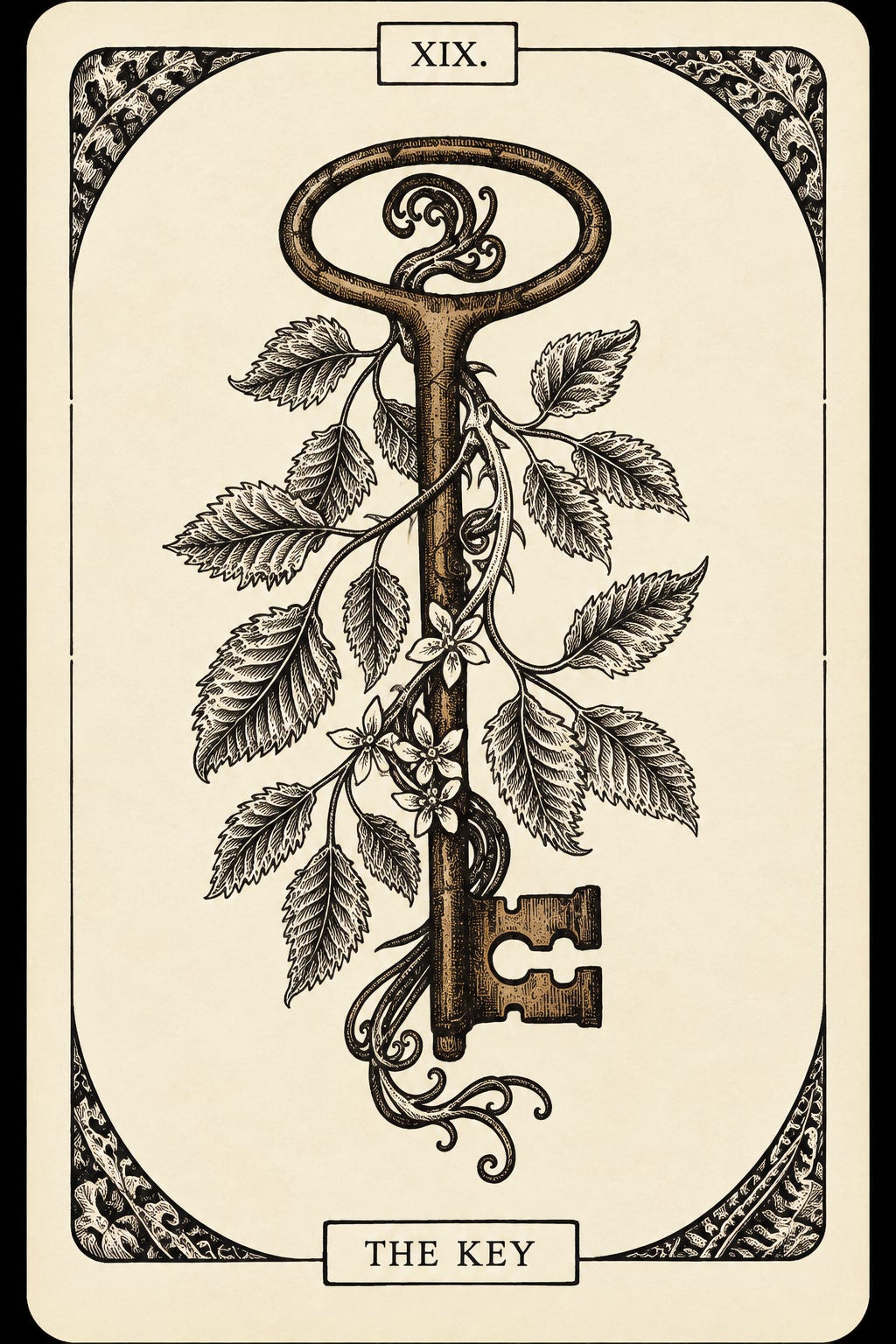
Diana’s story begins with something that has effectively been locked away for centuries. When she calls Ashmole 782 from the Bodleian stacks, she doesn’t know why the manuscript has been hidden, why it has responded to her, or why so many creatures are desperate to possess it. She simply knows that she has somehow opened something other people could not.
At first, everyone else seems to know more about what is happening than Diana does. Matthew has secrets. The Congregation has rules she barely understands. Peter Knox wants information from her. Even her own family history contains things she has never been told. Diana may have been able to open Ashmole 782, but other people still seem to be holding most of the keys.
That changes over the course of the series. Diana doesn’t simply uncover hidden knowledge. She gradually becomes someone who has to decide what should happen to that knowledge once it is found.
Miriam faces a similar responsibility from a very different direction. As a scientist, her instinct is to understand. Her work with Matthew on creature genetics and blood rage asks questions that witches, vampires, and daemons have spent centuries answering through tradition, fear, and assumption rather than evidence.
Scientific discovery gives Miriam the ability to unlock information that could fundamentally change how creatures understand themselves. But discovery creates its own problems.
Knowledge about blood rage could help families who have lived with fear and secrecy for generations. Genetic discoveries could challenge the divisions separating creatures. The same information, however, could become dangerous if it fell into the hands of someone who wanted to use it to identify, control, or harm others.
Miriam doesn’t simply possess knowledge. She has to think about what possessing it requires of her.
Chris Roberts makes that question even more interesting because he comes to it as a human. Chris hasn’t spent centuries accepting the creature world’s rules about what can and cannot be discussed. He is a scientist presented with extraordinary questions, and his instinct is to investigate them. That outsider perspective allows him to see possibilities that creatures steeped in their own history may miss.
But Chris eventually becomes responsible for knowledge that extends far beyond an interesting scientific problem. What he learns has implications for people he cares about and for an entire population whose existence most humans don’t even know about. Suddenly, opening the door isn’t the end of the scientific process. It’s the beginning of an ethical one.
Then there is Gerbert.
Gerbert understands the value of information too, but his relationship with it is very different. For him, knowledge can be valuable precisely because someone else doesn’t possess it. A secret can become leverage. Information can be revealed selectively, withheld strategically, or used to preserve power.

That distinction runs throughout All Souls. Miriam and Chris seek knowledge because they want to understand. Diana seeks it because understanding the past helps her make sense of the present. Gerbert repeatedly reminds us that knowledge can also be accumulated because controlling information means controlling other people.
And that makes The Key much more complicated than a symbol of discovery.
All Souls never really argues that every secret should be revealed. Matthew sometimes withholds information because he believes he is protecting people. Philippe spent centuries making decisions about what his family needed to know and when they needed to know it. Rebecca and Stephen made choices about Diana’s magic because they believed keeping certain things from her would keep her safe.
Sometimes they were right. Sometimes their protection became another form of control.
That may be the real question The Key opens for me: At what point does protecting someone by withholding knowledge become denying them the right to make their own choices?
Diana spends much of the series pushing against that boundary. She begins surrounded by people who believe they know what she should be told, what she can handle, and what she needs to be protected from. As she learns more about her powers, her parents, the Book of Life, and the creature world itself, she increasingly claims the right to decide those things for herself.
By the end, Diana isn’t simply the woman who could unlock Ashmole 782. She has become someone capable of deciding which doors should be opened, which should remain closed, and—perhaps most importantly—who else deserves a key.
Your Draw
If one secret could be unlocked for any character in All Souls, who would you give The Key to—and what do you think they most deserve to know?