
The Falcon and the Rose: The Rose
Are the symbols in Deborah Harkness’s new title pointing us toward Tudor history?

When Deborah Harkness announced the title of the next novel in the All Souls world — The Falcon and the Rose — early last year it immediately sounded like one of those historical riddles she likes to hide in plain sight.
Titles in this series rarely appear by accident.
A Discovery of Witches introduced the search for hidden knowledge.
Shadow of Night carried us into Elizabethan England.
The Book of Life pointed toward the deeper origins of creatures themselves.
So, while we wait for the next book to arrive (hopefully soon!), it seems like a good time to do what scholars do when faced with an intriguing clue.
Spend a little time between the stacks and see where the history leads.
The first symbol in the title gives us a fairly strong starting point.
The rose.
The Tudor Rose
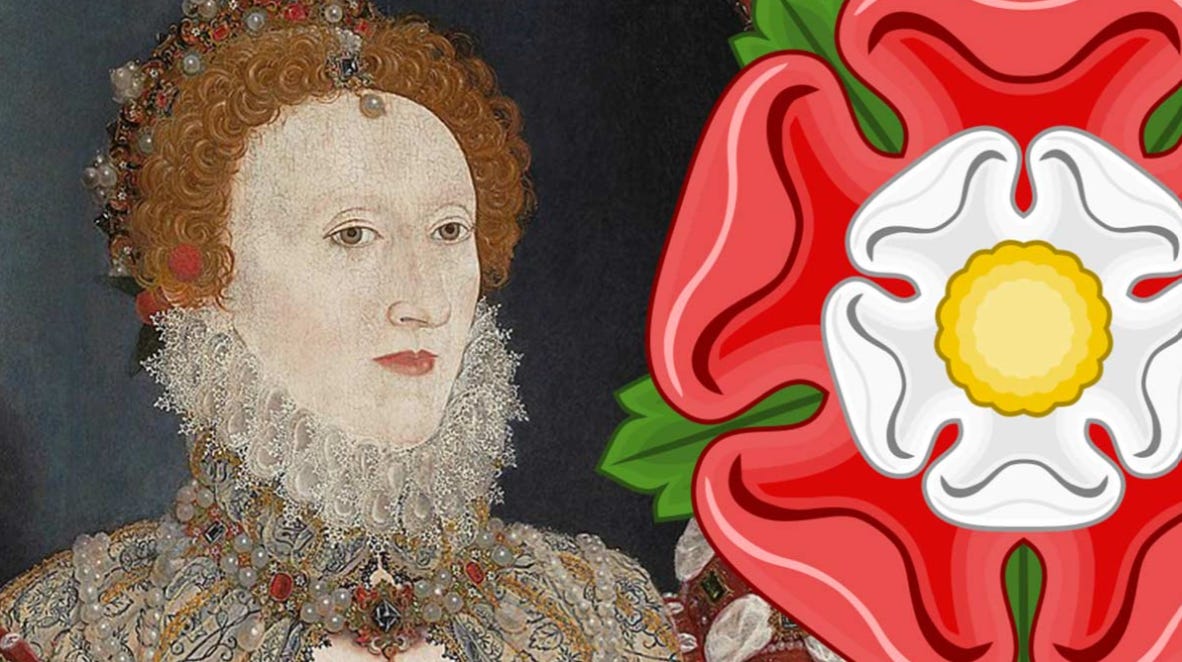
The rose most closely associated with English history is the Tudor Rose, created at the end of the Wars of the Roses (1455–1487).
The conflict was fought between two rival royal houses:
The House of Lancaster, symbolized by a red rose
The House of York, symbolized by a white rose
When Henry VII defeated Richard III at the Battle of Bosworth in 1485, he married Elizabeth of York, symbolically uniting the two dynasties.
The emblem that followed combined the red and white roses into a single symbol: the Tudor Rose.
It quickly became a powerful statement of political unity and royal legitimacy.
You can still see Tudor roses throughout England today — carved into palace ceilings, printed in manuscripts, and woven into the decorative language of Tudor architecture.
By the reign of Elizabeth I, the rose had become one of the most recognizable symbols of the English crown.
Why the Rose Matters
If the rose in Deborah Harkness’s title refers to the Tudor Rose, it would connect the story directly to the dynasty that shaped Elizabethan England.
That matters because Elizabeth’s court already plays a central role in the All Souls world, the place where Matthew moves quietly among scholars, courtiers, and spies under the name Matthew Roydon in Shadow of Night.
Deborah Harkness, a historian of Renaissance science, often builds her novels around real intellectual networks and historical symbolism.
Which makes the appearance of the rose feel less like decoration and more like a possible clue.
If you enjoy wandering deeper into the worlds behind the books we love, subscribe below.