

Experience The Black Bird Oracle Special Series in a new way. Click the READ IN APP button to open this article, then tap Listen to hear this article’s audio companion - perfect for when you’d rather listen than read. Because sometimes, the words we need are meant to be heard.
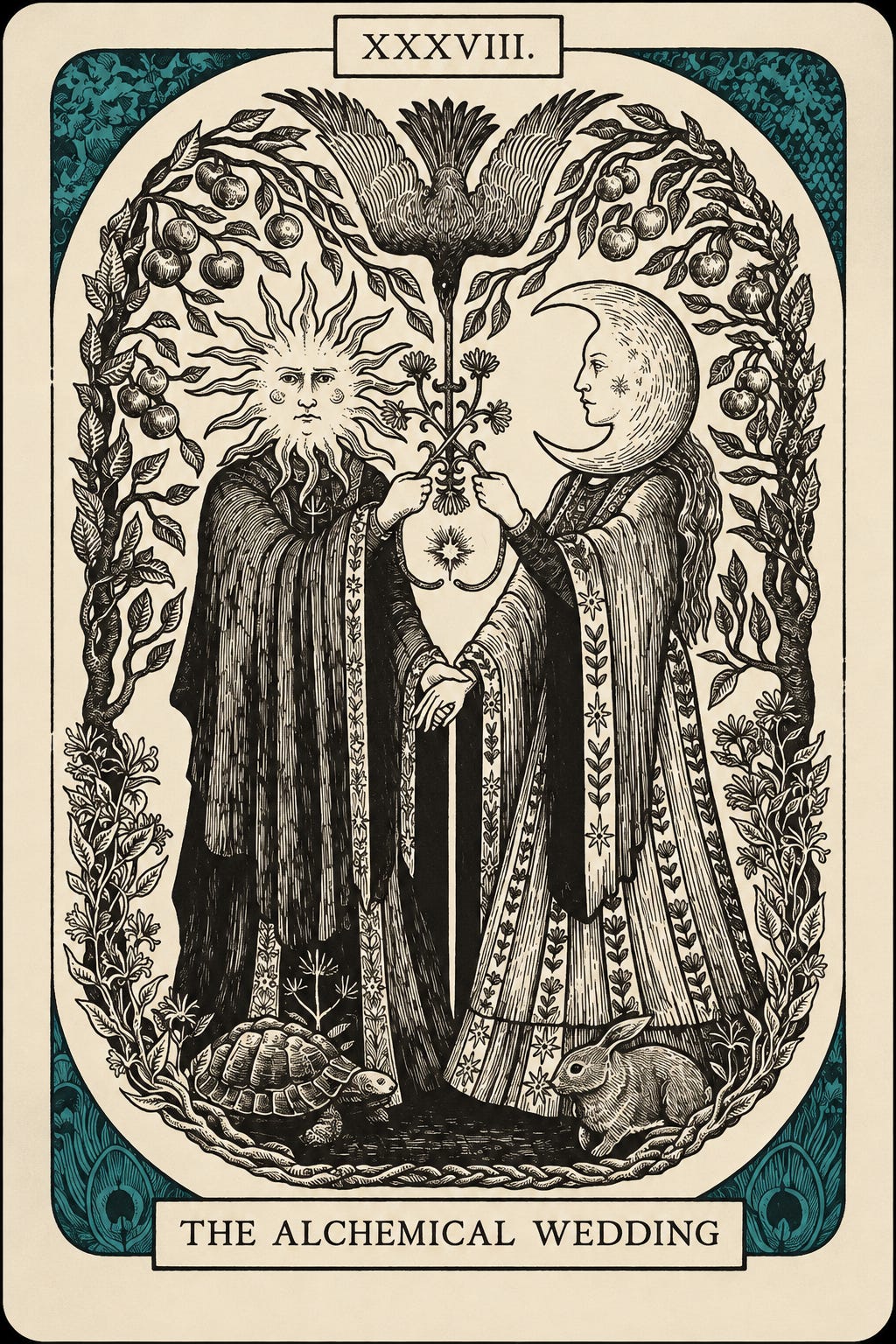
Of all the cards in The Black Bird Oracle, The Alchemical Wedding may be the one that feels most obviously connected to Diana and Matthew.
The guidebook gives us:
Harmony. Opposites. Attraction.
And anyone who has read A Discovery of Witches knows how easily those words fit.
A witch and a vampire. Warmblood and coldblood. Scholar and scientist. Two creatures who have been taught that relationships like theirs are forbidden, falling in love anyway.
It would be very easy to stop there.
But the more I thought about The Alchemical Wedding, the less interested I became in Diana and Matthew as a love story and the more interested I became in what their relationship does.
Because relationships in All Souls rarely affect only the two people involved.
They disrupt families.
They challenge laws.
They expose prejudices.
They create new alliances.
And sometimes they change what everyone around them believes is possible.
That makes Diana and Matthew’s relationship much more than a romance.
Their decision to be together forces almost every major structure in their world to respond. The de Clermont family has to make room for Diana. The Bishops have to make room for Matthew. The Congregation has to confront a relationship prohibited by the Covenant. And eventually their children force creatures to reconsider assumptions about the boundaries separating witches, vampires, and daemons.
Their union doesn’t simply combine two people.
It creates something that didn’t exist before.
That is, of course, one of the central ideas of alchemy.
Transformation isn’t simply about putting two substances next to each other. The interesting part is what happens when their interaction produces something new.
And once I started looking at relationships in All Souls that way, Diana and Matthew stopped being the only interesting example.
Consider Marcus and Phoebe.
Their relationship begins in a very different world from Matthew and Diana’s. Marcus belongs to an ancient vampire family but is continually drawn toward change. Phoebe enters that world from the outside and makes the extraordinary decision to become a vampire herself.
But Phoebe doesn’t simply disappear into Marcus’s identity.
She brings her own intelligence, judgment, professional experience, and sense of self into the relationship. Their partnership asks a question that is different from Diana and Matthew’s but just as important: How do you join an ancient family without allowing its history to determine who you become?
Marcus and Phoebe represent something the de Clermont family desperately needs.
A future that isn’t simply a reproduction of its past.
Then there are Nathaniel and Sophie.
Their relationship may be quieter, but in some ways it is even more radical.
A daemon and a witch create a family together despite the divisions that have governed creatures for generations. Sophie’s connection to the Bishop family further complicates everything creatures believe they know about inheritance and identity.
Long before anyone fully understands the science behind creature relationships, Nathaniel and Sophie are already living the contradiction.
Their family exists.
Reality arrives before the rules are ready for it.
And then there is Hugh and Fernando.
Their story changes the question again.
Hugh and Fernando remind us that sometimes the problem isn’t whether two people belong together.
It’s whether the world around them is willing to recognize that they do.
Fernando’s place within the de Clermont family exposes the limits of structures that claim to protect families while failing to recognize relationships that don’t fit comfortably within their rules.
His love for Hugh isn’t less real because an institution failed to honor it.
If anything, the persistence of that love makes the institution look inadequate.
And suddenly The Alchemical Wedding begins to feel like something much larger than a marriage card.
It becomes a card about what happens when two people create a relationship that challenges the categories around them.
Diana and Matthew challenge the separation of species.
Marcus and Phoebe challenge the idea that joining an ancient family requires simply accepting its traditions.
Nathaniel and Sophie challenge assumptions about creature identity and inheritance.
Hugh and Fernando challenge the boundaries of which relationships are allowed to count as family.
Different couples.
Different circumstances.
But the same underlying idea.
A relationship can change more than the people inside it.
Perhaps that’s what Deborah Harkness has been exploring all along.
Love in All Souls is rarely passive. It rearranges things.
It forces families to expand their definitions of belonging. It exposes rules that no longer make sense. It creates children, alliances, loyalties, and possibilities that couldn’t have existed before.
That’s transformation.
And maybe that’s why The Alchemical Wedding belongs so naturally in this world.
The real magic isn’t that two opposites find one another.
It’s what becomes possible after they do.
Your Draw
Which relationship in All Souls do you think changed the world around it the most—and was that change something the couple intended, or simply the consequence of choosing each other?