

Experience The Black Bird Oracle Special Series in a new way. Click the READ IN APP button to open this article, then tap Listen to hear this article’s audio companion - perfect for when you’d rather listen than read. Because sometimes, the words we need are meant to be heard.
Some cards in The Black Bird Oracle invite interpretation.
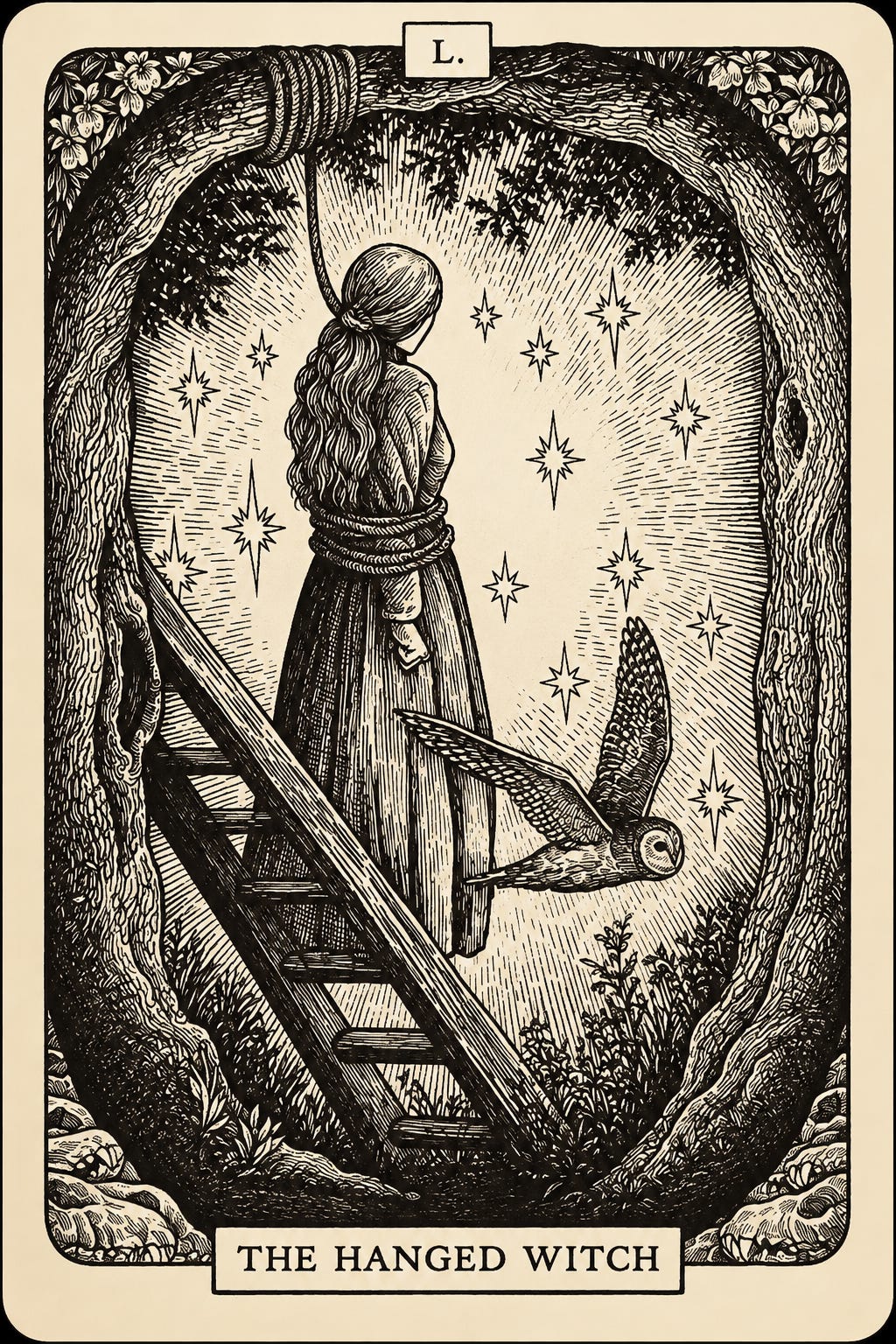
The Hanged Witch doesn’t give us that luxury.
The image is unsettling, and the words Deborah Harkness gives the card are equally direct:
Endings. Reversal. Injustice.
The guidebook places the card within a history of persecution, sacrifice, and people punished because their beliefs or powers threatened the world around them.
That history has always been present in All Souls.
Diana Bishop carries the name of a family forever associated with Salem. She is a descendant of Bridget Bishop, the first person executed during the Salem witch trials of 1692. Long before Diana understands the full extent of her powers, she knows what being a Bishop means.
But Diana isn’t the character I thought about first when I looked at this card.
I thought about Sarah.
Sarah Bishop lives openly as a witch in a way Diana initially refuses to do. She practices magic, teaches it, argues about it, and treats being a witch not as something separate from her identity but as part of the fabric of her life.
That feels different when we remember the women who came before her.
Sarah can do openly what generations of women could not. She can possess knowledge without hiding it, live with another woman she loves, build a home filled with magic, and teach the next generation without the same fear that surrounded her ancestors.
Her freedom is ordinary to her.
Historically, it is extraordinary.
Then there is Emily.
Emily’s place in this conversation matters because All Souls repeatedly expands the meaning of inheritance beyond blood.
Emily isn’t a Bishop by ancestry. Yet she helps raise Diana. She shares Sarah’s life. She belongs to the family and participates in preserving and passing on magical knowledge.
Her story reminds us that traditions don’t survive only because parents give them to children.
Sometimes they survive because someone chooses to carry them.
And sometimes that choice comes at a terrible cost.
Rebecca Bishop’s relationship to this history is different again.
Rebecca doesn’t merely inherit magic. She studies it scientifically. Along with Stephen, she tries to understand what Diana is and what her powers might mean. She belongs to a generation capable of asking questions about witchcraft that her ancestors could never safely have asked in public.
But Rebecca also understands danger.
She knows knowledge doesn’t automatically make prejudice disappear.
That tension—between how much has changed and how much hasn’t—runs throughout All Souls.
Which brings us back to Diana.
At the beginning of A Discovery of Witches, Diana believes the safest way to live is to distance herself from magic. She doesn’t deny her ancestry, but neither does she want it determining her life.
In one sense, that choice is completely understandable.
In another, it’s something Bridget Bishop never had.
Diana has the freedom not to practice.
That is its own kind of inheritance.
The women accused of witchcraft in earlier centuries were often denied the ability to define themselves at all. Other people decided what they were, what their actions meant, and whether they deserved to live.
Diana gets to choose.
She can reject magic.
She can reclaim it.
She can study it.
She can change how it is practiced.

Eventually, she can decide what parts of that inheritance she wants to pass to her own children.
Perhaps that’s where Becca becomes the most interesting character of all.
Becca is growing up in a world that earlier generations of Bishop and Proctor women helped make possible.
She inherits extraordinary abilities, but she also inherits something less obvious: generations of women gradually creating more room for the next woman to choose.
Bridget Bishop didn’t have that freedom.
Sarah fought to live inside it.
Rebecca tried to understand it.
Diana expanded it.
And Becca inherits what they built.
That doesn’t mean history moves neatly forward. All Souls never suggests that prejudice disappears simply because time passes. The Congregation itself demonstrates how old fears can become embedded in institutions and survive long after people forget why the rules were created in the first place.
But perhaps The Hanged Witch isn’t asking us only to remember injustice.
Perhaps it’s asking what should happen after we remember it.
History can become a warning.
It can become a burden.
Or it can become an obligation to make something different possible for the people who come next.
That’s what I see when I look at the witches of All Souls.
Not simply a magical bloodline.
A chain of women handing one another a little more freedom.
Your Draw
Which woman in All Souls do you think changed what was possible for the women who came after her—and who benefited most from what she changed?