

Experience The Black Bird Oracle Special Series in a new way. Click the READ IN APP button to open this article, then tap Listen to hear this article’s audio companion - perfect for when you’d rather listen than read. Because sometimes, the words we need are meant to be heard.
Some cards in The Black Bird Oracle seem almost suspiciously well suited to All Souls.
A Parliament of Owls is one of them.
Deborah Harkness gives the card three ideas:
Deliberation. Judgment. Seeing Both Sides.
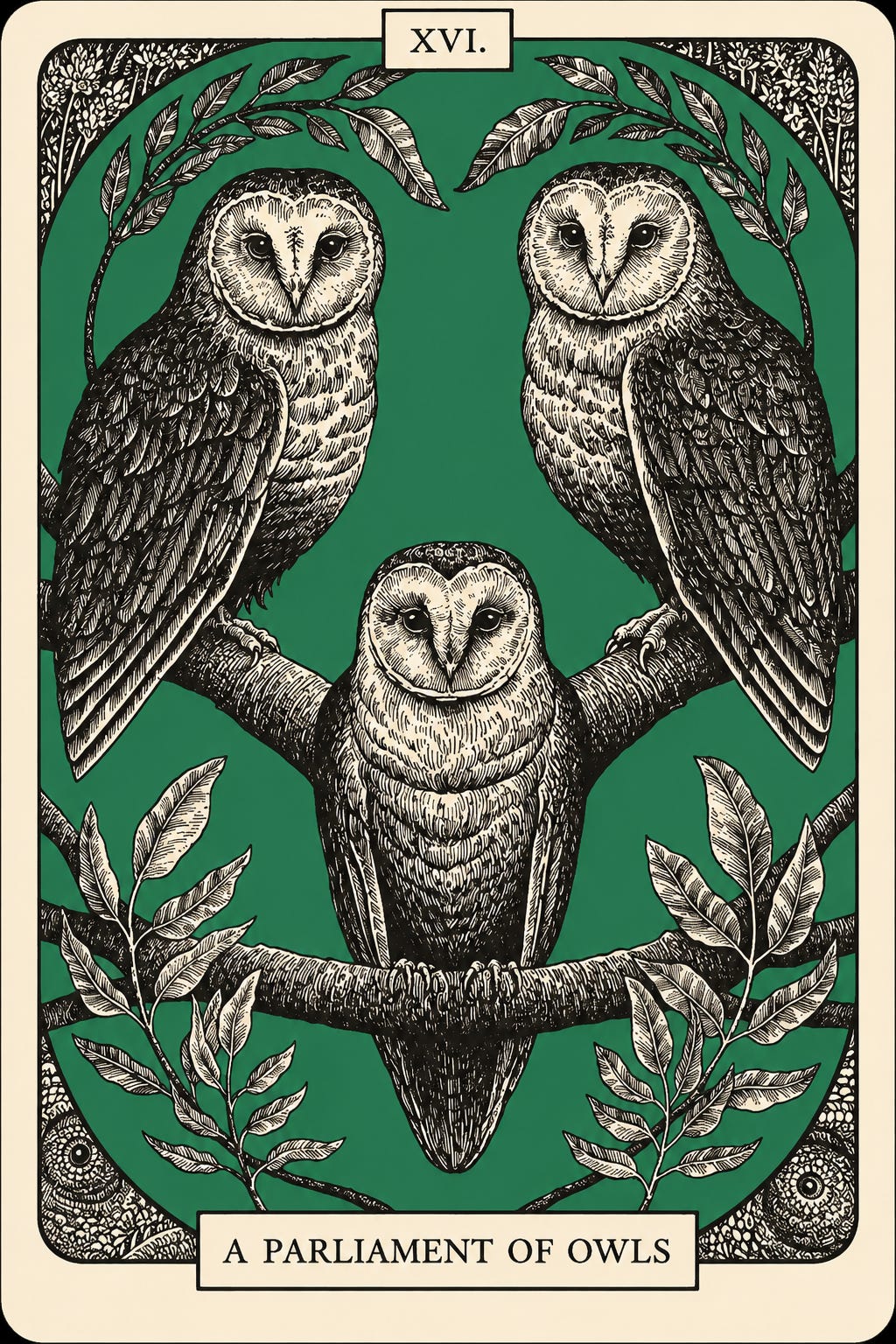
A group gathers. Different perspectives are considered. Information is weighed. Eventually, a judgment is made.
Sound familiar?
It should.
Because All Souls already has its own parliament.
The Congregation.
On paper, the Congregation is a remarkably sensible idea. Witches, vampires, and daemons share a world with humans who cannot know they exist. Power needs limits. Conflicts need somewhere to be resolved. No single species should be allowed to make every decision.
So nine creatures—three witches, three vampires, and three daemons—come together to govern.
It’s almost beautifully balanced.
Until you look at the creatures sitting in the chairs.
That’s where things get interesting.
The Congregation is supposed to represent different perspectives, but its members arrive carrying histories, loyalties, fears, ambitions, and prejudices of their own.
Agatha Wilson may be one of the most interesting people to consider through this card.
Daemons occupy a strange position in the creature world. They are one of its three recognized species, yet they frequently seem to have less power and less understanding of their own origins than witches or vampires. Agatha’s position on the Congregation gives her a seat at the table, but having a seat and having equal influence aren’t necessarily the same thing.
Her perspective becomes increasingly important because she is willing to question assumptions that other members have accepted for centuries.
Then there is Domenico Michele.
Domenico understands institutions extremely well.
He knows when to observe, when to gather information, when to wait, and when circumstances have shifted enough to make a different move possible. His loyalties can be difficult to read, but perhaps that’s exactly what makes him interesting on a governing body.
Domenico doesn’t always approach a question by asking who is right.
He often seems more interested in understanding where power is moving.
That’s not necessarily admirable.
But it may be realistic.
Institutions aren’t populated entirely by heroes and villains. They’re populated by people calculating risks, protecting interests, forming alliances, and deciding which battles matter enough to fight.
Satu Järvinen brings something entirely different to the table.
She is extraordinarily powerful, ambitious, and determined to understand abilities that have been hidden or suppressed. She also demonstrates how dangerous authority becomes when curiosity and power aren’t restrained by empathy.
Satu wants answers.

But wanting the truth doesn’t necessarily mean you’re capable of judging fairly.
Then there is Gerbert.
Gerbert may be the clearest example of the problem built into the Congregation itself.
What happens when someone entrusted with maintaining order benefits from keeping the existing order intact?
Gerbert has lived for centuries within the systems that govern creatures. He understands those systems, knows how to use them, and has very little incentive to question rules that preserve his influence.
And finally, there is Baldwin.
Baldwin is our familiar complication because he genuinely believes in order.
He understands why rules exist. He knows what can happen when powerful creatures act without restraint, and he carries responsibility for one of the oldest vampire families in existence.
But Baldwin also demonstrates the difficulty of separating public judgment from private obligation.
Can he ever sit on the Congregation only as a vampire representative when the decisions before him affect Matthew, the de Clermonts, and eventually Diana?
Can anyone?
That’s the question A Parliament of Owls makes me ask.
We often talk about fairness as though it requires people to leave their experiences outside the room.
But nobody does that.
Agatha arrives as a daemon.
Satu arrives as a witch with her own ambitions and experiences.
Baldwin arrives as Philippe’s son.
Domenico and Gerbert arrive carrying centuries of alliances and rivalries.
Every person judging the case is already part of the story.
Perhaps the problem with the Congregation isn’t simply that some of its members are corrupt, prejudiced, or self-interested.
Perhaps the deeper problem is that the institution mistakes representation for perspective.
Putting three witches, three vampires, and three daemons in a room doesn’t automatically mean every point of view is being heard.
And having equal numbers doesn’t guarantee equal power.
That’s something Diana ultimately forces the creature world to confront.
The discoveries surrounding the Book of Life reveal that the divisions everyone has spent centuries defending aren’t nearly as clear as they believed. The categories upon which the Congregation built its entire governing system turn out to be more complicated than the institution itself.
Which makes the image of a parliament of owls particularly fitting.
Owls are associated with wisdom.
A parliament suggests deliberation.
But neither guarantees a wise decision.
For that, the people in the room have to be willing to do the hardest thing of all:
discover that what they have always believed may be wrong.
Your Draw
If you could give one additional All Souls character a seat on the Congregation, who would you choose—and whose perspective do you think the institution is missing most?