

Experience The Black Bird Oracle Special Series in a new way. Click the READ IN APP button to open this article, then tap Listen to hear this article’s audio companion - perfect for when you’d rather listen than read. Because sometimes, the words we need are meant to be heard.
The Dark Moon sounds like it should be one of the more ominous cards in The Black Bird Oracle.
Instead, Deborah Harkness gives it a surprisingly hopeful meaning:
Rising energy. Fresh ideas. Beginnings.
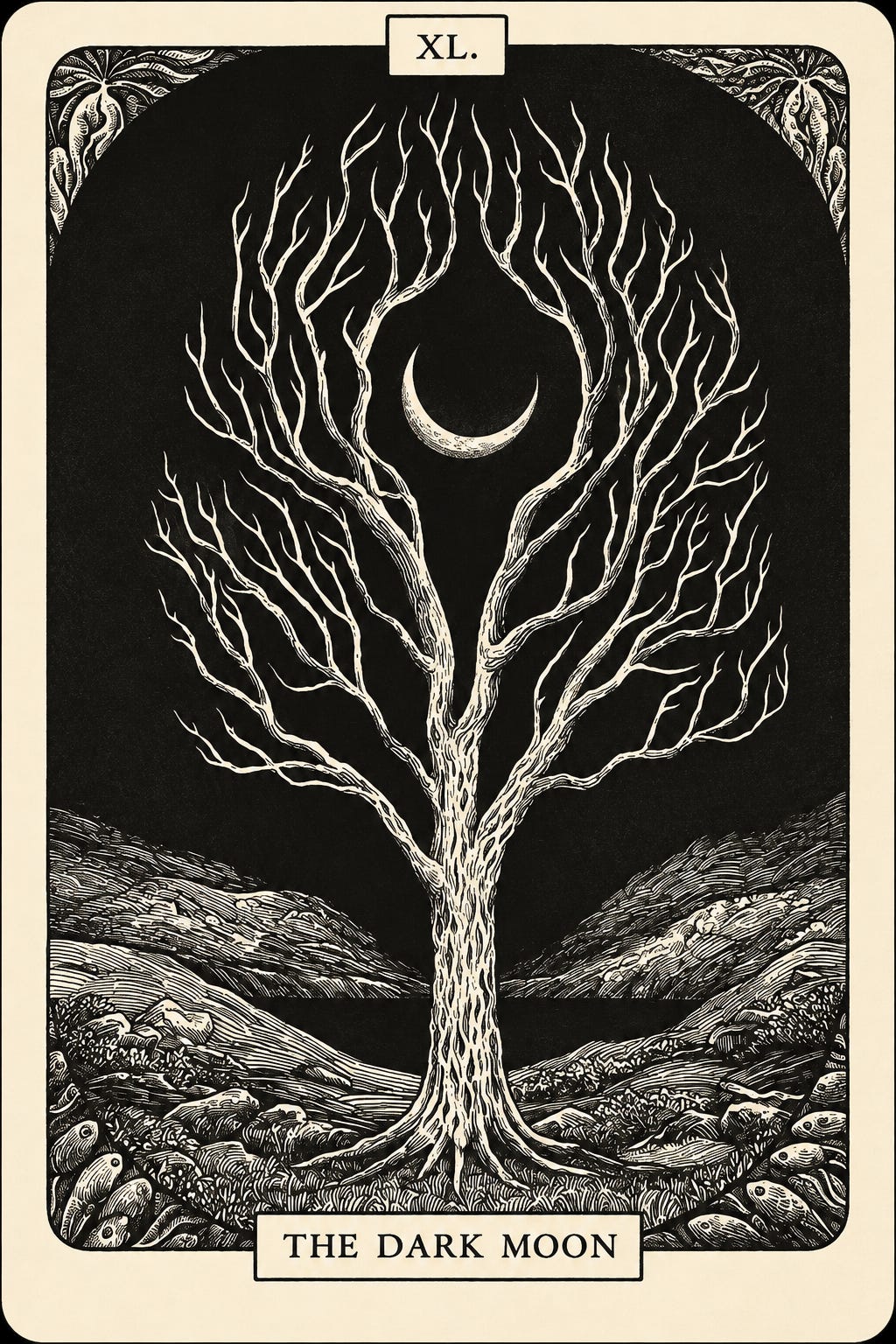
The Black Bird Oracle Deck guidebook describes the Dark Moon as the time before something new becomes visible. The moon hasn’t disappeared. It’s simply hidden from our view.
That distinction made me think about how often the same thing happens to the characters in All Souls.
Some of the most important beginnings in their lives don’t arrive looking like beginnings at all.
They arrive as uncertainty.
Loss.
A decision whose consequences they can’t possibly understand.
A step forward without any guarantee of where it will lead.
And perhaps no character demonstrates that better than Marcus.
When Matthew makes Marcus a vampire during the American Revolution, Marcus isn’t simply beginning a longer version of the life he already had. The human life he understood is over.
Everything familiar about time, family, aging, and even his own body changes.
Marcus cannot possibly see the life ahead of him.
And what I find particularly interesting is that the vampire Marcus eventually becomes isn’t simply a younger version of Matthew.
He questions things.
He creates relationships differently. He builds his own family. He becomes increasingly willing to challenge traditions that have governed the de Clermonts for centuries.
What begins in uncertainty eventually becomes the possibility of doing things differently.
Phoebe chooses that uncertainty for herself.
Her decision to become a vampire is fascinating because she knows far more about what awaits her than Marcus ever could—and still cannot truly know what the experience will be until she crosses into it.
Phoebe has to leave one version of herself behind without being able to meet the woman who will emerge on the other side.
That requires a particular kind of courage.
Not the courage that comes from knowing everything will work out.
The courage to begin when you can’t know.
Then there is Jack.
Jack’s story contains more darkness than almost anyone’s in All Souls.
When Diana and Matthew leave Elizabethan London, the child they love cannot understand the strange mechanics of timewalking. He only knows that the people who became his family are gone.
What follows is hardly the future they would have chosen for him.
Jack survives loss, violence, manipulation, and centuries of consequences created partly by other people’s decisions. When we encounter him again, it would be easy to see his story entirely through what has happened to him.
But Jack’s story doesn’t end there.
Being reunited with Matthew and Diana doesn’t erase the intervening centuries. It doesn’t return him to the child he was, and it doesn’t magically remove everything he has done or endured.
It gives him something else.
Another beginning.
That’s very different.
All Souls repeatedly refuses the comforting idea that beginning again means returning to who you were before something went wrong.
Sometimes there is no going back.
You begin from where you are.
And, of course, we can’t talk about beginnings without Diana.
Diana’s begins with a book.
When she calls Ashmole 782 from the Bodleian stacks, she thinks she is doing something entirely ordinary: requesting a manuscript for her research.
She has no idea what she has just started.
She doesn’t know Matthew.
She doesn’t understand her own powers.
She doesn’t know why the manuscript has responded to her or why other creatures are suddenly interested in what she has found.
From Diana’s perspective, almost everything ahead is hidden.
And yet the entire All Souls story is already beginning.
That’s what I love about looking at that moment through The Dark Moon.
We know what’s coming because we’ve read the books.
Diana doesn’t.
She is standing at the beginning of a life she cannot yet see.
And perhaps that’s what makes Becca such an interesting place to end.
Becca is growing up after so many of the boundaries that defined her parents’ world have begun to change. She inherits the consequences of choices made by Diana and Matthew, Philippe, Rebecca and Stephen, Sarah and Emily, Marcus and Phoebe, and generations of Bishops, Proctors, and de Clermonts.
But none of them can know exactly what she will do with that inheritance.
Nor should they.
Her future is supposed to be unknown.
That’s the promise of a new generation.
The Dark Moon reminds us that beginnings rarely announce themselves.

Sometimes we recognize them only much later, when we look back and realize that the moment that felt confusing, frightening, or insignificant was actually the point at which everything started to change.
Maybe that’s why this card feels so right for the week of All Hallow’s Eve.
This is the season when we naturally think about darkness as something mysterious or frightening. We tell ghost stories. We remember the dead. We allow ourselves, for a night, to be a little more interested in what we can’t see.
But darkness doesn’t always mean something is ending.
Sometimes it simply means the next thing hasn’t revealed itself yet.
Your Draw
Which moment in All Souls looked like an ending when it happened—but turned out to be the beginning of something entirely new?