

Experience The Black Bird Oracle Special Series in a new way. Click the READ IN APP button to open this article in the Substack app, then tap Listen to hear this article’s audio companion — perfect for a walk, a drive, or your morning coffee when you’d rather listen than read, because sometimes we need to hear the words we need.
The Loom is one of those cards in The Black Bird Oracle that immediately feels at home in the world Deborah Harkness has created.
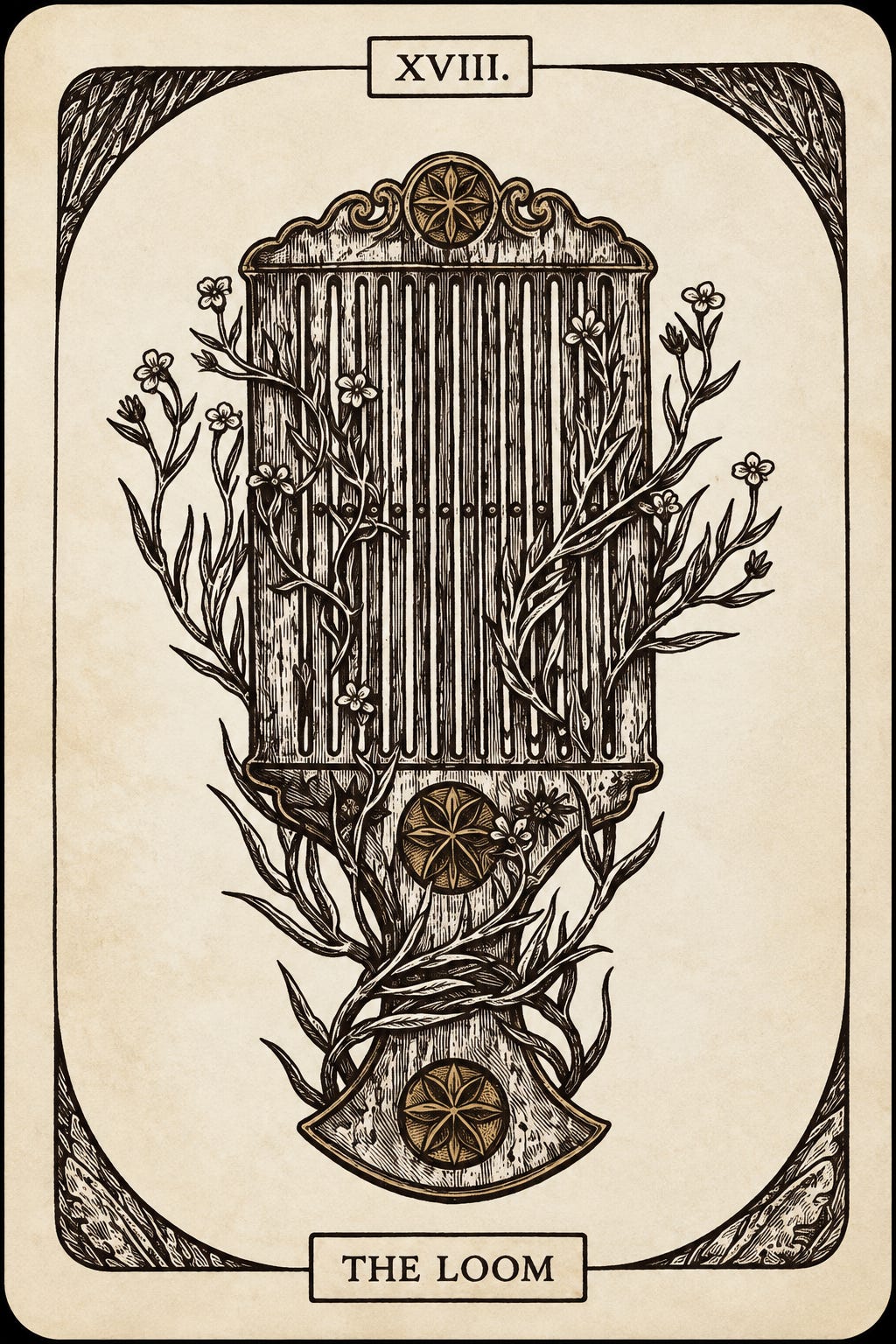
Its ideas are fate, time, and destiny—three things that seem to follow Diana Bishop from the moment she calls Ashmole 782 from the Bodleian stacks.
It would be easy to look at Diana’s life and conclude that much of it was destined to happen. She is born into two remarkable magical families. She unknowingly possesses extraordinary abilities. She calls up a manuscript that other creatures have been searching for for centuries. She meets Matthew. She timewalks. She discovers the Book of Life. Eventually, she becomes central to changing a system that has governed creatures for generations.
Viewed from a distance, the pattern looks almost too perfect to be accidental.
But The Loom made me wonder whether All Souls is really a story about destiny at all.
Maybe it’s a story about people creating the conditions that allow someone else’s future to happen.
And if that’s true, there are far more hands on the loom than we might initially think.
Philippe is perhaps the most obvious.
He spends centuries thinking ahead, building alliances, strengthening the de Clermont family, and making decisions whose consequences extend far beyond his own lifetime. Even after his death, choices Philippe made continue to shape Matthew, Baldwin, Ysabeau, and eventually Diana.
Philippe understands something that few other characters do as well: you don’t have to live to see the final pattern in order to influence it.
But Philippe isn’t the only one weaving.
Rebecca Bishop and Stephen Proctor make decisions that shape Diana’s life long before she is capable of understanding them. They know their daughter is unusual. They understand that forces surrounding her could become dangerous, and their attempts to protect her affect Diana long after they are gone.
That protection comes with consequences.
Diana grows up believing that avoiding magic is a choice she made entirely for herself. Only later does she begin to understand how much of her relationship with magic was shaped by decisions made by her parents.
That raises an uncomfortable question: When someone changes the course of your life to protect you, is that fate—or is it simply someone else pulling a thread?
Then there are Sarah and Emily.
I think they’re particularly interesting through the lens of The Loom because their influence is quieter.
They don’t determine Diana’s future. They do something perhaps more important: they give her a place from which she can eventually choose it.
After Rebecca and Stephen die, Sarah and Emily raise Diana. They give her a family, preserve her connection to the Bishop line, and allow her to become a scholar even when that means watching her distance herself from magic.
They don’t force Diana toward the person she will become.
They keep enough threads intact for her to find her own way back.
And that distinction matters.
Because by the time we reach the later books, Diana is no longer simply living inside a pattern created by other people.
She begins weaving.

Her marriage to Matthew changes both the Bishop and de Clermont families. Their children challenge assumptions about what creatures can be. Diana’s discoveries about the Book of Life alter what creatures understand about themselves, while her willingness to confront the Congregation challenges rules that have governed their world for centuries.
The woman whose life was shaped so profoundly by other people’s choices eventually begins making choices that will shape lives she may never know.
That feels much more interesting to me than destiny.
It also makes me think differently about timewalking.
Diana can literally move through time, but even she cannot move through it without consequences. The past isn’t a place she can simply visit and leave untouched. Relationships are created there. Knowledge travels back with her. Choices made centuries earlier become part of the future.
Time in All Souls doesn’t behave like a straight line.
It looks much more like fabric.
Threads cross. Some disappear beneath the surface and emerge much later. One person’s choices become part of another person’s story, sometimes generations before those people ever meet.
And perhaps that’s what The Loom makes visible.
No single character is sitting above the story controlling everything.
Not Philippe.
Not Rebecca and Stephen.
Not Diana.
Instead, each inherits threads from the people who came before and adds something of their own before passing them forward.
That may be one of the most beautiful ideas running through All Souls: we are shaped by people whose choices we didn’t make, but we aren’t trapped by the pattern they began.
Eventually, the thread reaches our hands.
And we get to decide what happens next.
Your Draw
Who do you think quietly changes the course of the All Souls story more than anyone realizes?
Not necessarily the most powerful character or the one at the center of the story. Think about the person whose choices send threads outward—and change what becomes possible for everyone who comes after.