

The Mirror seems, at first, like one of the simplest cards in The Black Bird Oracle Deck. We all know what a mirror does. We look into it and expect to see ourselves looking back.
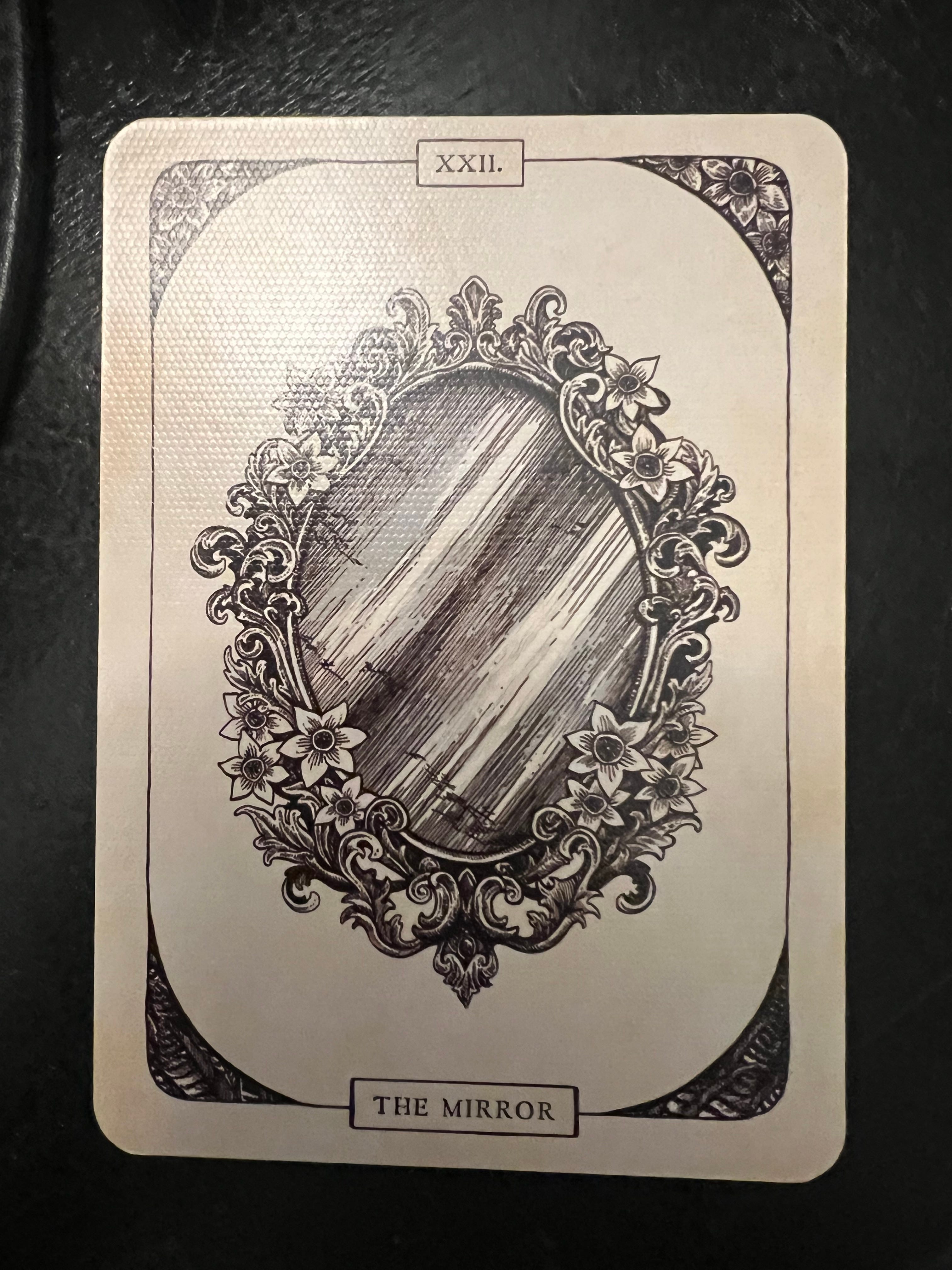
Except Deborah Harkness gives The Mirror three words that make the idea much more interesting:
Revelations. Distortions. Reflections.
The guidebook reminds us that mirrors can reveal, but they can also distort. What we see reflected back at us isn’t necessarily the truth, particularly when our own fears, expectations, and histories influence what we believe we are seeing.
That made me wonder about the characters in All Souls.
If we could take The Mirror out of the deck and place it in front of one of them, who would have the hardest time seeing themselves clearly?
My first answer was Matthew.
Matthew carries an extraordinarily fixed idea of who he is. He sees the violence in his past, his blood rage, the people he has killed, the mistakes he has made, and the danger he believes he represents to the people around him. Even when others see something different in him, Matthew has difficulty letting go of the darkest parts of his own reflection.
Diana sees him differently.
She certainly doesn’t ignore what he is capable of, but she refuses to accept that his worst actions are the entirety of who he is. Again and again, Matthew’s understanding of himself comes into conflict with the man Diana believes him to be.
So what would The Mirror reveal to Matthew?

Would he finally see the person Diana sees, or would his own history continue to distort the reflection?
Then I thought about Diana, and the answer became less obvious.
When we first meet Diana Bishop in A Discovery of Witches, she has constructed a very specific identity for herself. She is a historian. A scholar. A professor. She is someone who works hard, thinks rationally, and has built a life around books, archives, teaching, and research.
She is also a witch who has spent years insisting that being a witch isn’t particularly important to who she is.
Diana’s problem isn’t that she doesn’t know she’s a witch. She knows exactly what she is. Her distortion lies in believing she can separate that part of herself from everything else.
It takes the events surrounding Ashmole 782—and eventually Matthew, Sarah, Emily, Philippe, and others—to force Diana to reconsider the reflection she has created for herself. Becoming more powerful doesn’t turn her into someone new. In many ways, it reveals the person who was there all along.
That makes Diana a very strong candidate for The Mirror.
But then there is Baldwin.
Baldwin is fascinating because I’m not sure his reflection is distorted so much as incomplete.
He sees himself as the person responsible for the survival of the de Clermont family. Philippe’s death leaves Baldwin with obligations that extend far beyond his own desires, and he frequently makes decisions from the position of someone who believes that protecting the family sometimes requires being the person everyone else resents.
The question is whether Baldwin sees the difference between protecting the family and controlling it.
Other members of the de Clermont family certainly do.
Put The Mirror in front of Baldwin and I suspect the most interesting question wouldn’t be whether he likes what he sees. It would be whether the reflection matches the man he believes himself to be.
And then we come to Gallowglass.
Of all these characters, he may be the one I find most difficult to place.
Gallowglass knows who he is remarkably well. He understands his loyalties, his responsibilities, and his feelings. He isn’t hiding from the truth in quite the same way Matthew and Diana sometimes do.
But knowing yourself and building a life for yourself aren’t necessarily the same thing.
So much of Gallowglass’s identity has been shaped by what he does for other people—by loyalty, promises, family, and a love that cannot become the life he might have wanted. Put The Mirror in front of him and I don’t think it would reveal a secret.
It might ask a much harder question:
Who are you when no one needs you?
Perhaps that’s why The Mirror is such an interesting place to begin this series.
There isn’t one character who belongs to this card.
Matthew’s reflection is darkened by guilt.
Diana’s is complicated by the parts of herself she spent years refusing to acknowledge.
Baldwin’s may be shaped by duty.
Gallowglass’s by devotion.
Each of them looks into the same mirror and sees something different because each brings a different history to the glass.
And that feels very All Souls.
Deborah Harkness has never been particularly interested in characters who are exactly what they first appear to be. Historians know better than that. People, like manuscripts, accumulate layers. Some are visible. Others have been erased, rewritten, hidden, or misunderstood.
Sometimes the hardest thing isn’t discovering the truth.
It’s recognizing yourself when you finally see it.
Your Draw
Which All Souls character sees themselves most differently from the way everyone else sees them?
Tell me who would you choose and what you think they’re getting wrong.