

When I first began thinking about a series inspired by The Black Bird Oracle Deck, I thought I would write about the history behind the cards. There is certainly plenty to explore. Deborah Harkness has filled the deck with birds, alchemical processes, magical tools, moon phases, elements, and symbols whose histories stretch back centuries.
Then I spent some time with the actual deck.
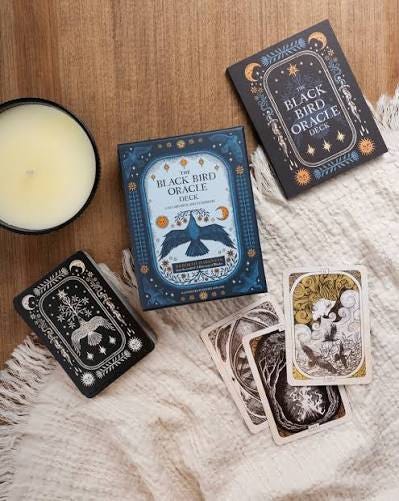
I went through the 52 cards, read the guidebook, looked at the illustrations, and paid particular attention to the words Deborah chose to associate with each card. The Mirror is about revelations, distortions, and reflections. The Box holds personal baggage and the unknown. The Loom represents fate, time, and destiny. Blood speaks to deep bonds, the self, and vitality. The Skeleton is about building, structure, and support.
And I realized I didn’t really want to explain any of them.
Deborah has already done that. Duh…right?
What I actually want to do for this series is take a look at what would happen if we took the ideas in these cards and turned them back toward the characters we’ve been reading about for years.
Take The Mirror.
The guidebook asks us to think about what a mirror reveals—and what it can distort. But put that card into the world of All Souls and a much more interesting question appears: Which character has the hardest time seeing themselves clearly?
Is it Matthew, who so often sees himself through the worst things he has done rather than the man Diana sees?
Is it Diana, who spends years believing that magic is something she can simply choose not to be part of?
Is it Baldwin, whose understanding of himself as protector of the de Clermont family doesn’t always match the way the rest of the family experiences him?
Or perhaps Gallowglass, whose loyalty to others has shaped so much of the life he has allowed himself to live?
Suddenly The Mirror isn’t something we’re interpreting.
It’s something we’re using.
And there are 51 more cards waiting for us.
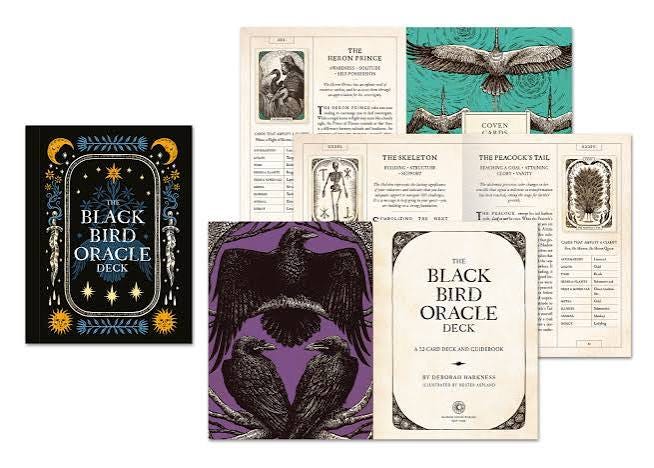
The Box makes me wonder what the characters in All Souls are carrying that was handed to them by someone else.
The Loom raises the question of who is really pulling the threads of fate throughout the series.
The Skeleton makes us look at the de Clermont family and ask what actually holds them together when everything else is stripped away.
The Alchemical Wedding gives us an entirely new way to think about Matthew and Diana’s marriage.
And then there is Blood, which may open one of the biggest questions in the entire series: Is blood destiny in All Souls, or has Deborah Harkness spent seven books showing us that it isn’t?
These are the questions I want to explore.
So this series is going to work a little differently than I originally imagined. What else is new, right?
Each week, we’ll draw one card from the Black Bird Oracle and use it as a way into the world of All Souls. We’ll start with the meaning Deborah gives the card, but we won’t stay there. Instead, we’ll turn it toward the characters, relationships, families, and choices we’ve been following since Diana first called Ashmole 782 from the Bodleian stacks.
Some cards may lead us back to Diana and Matthew. Others may take us to Philippe, Ysabeau, Baldwin, Gallowglass, Sarah, Marcus, Phoebe, Becca, or characters we haven’t thought about in a while. And some may make us reconsider a question we thought the books had already answered.
There are 52 cards in the Black Bird Oracle.
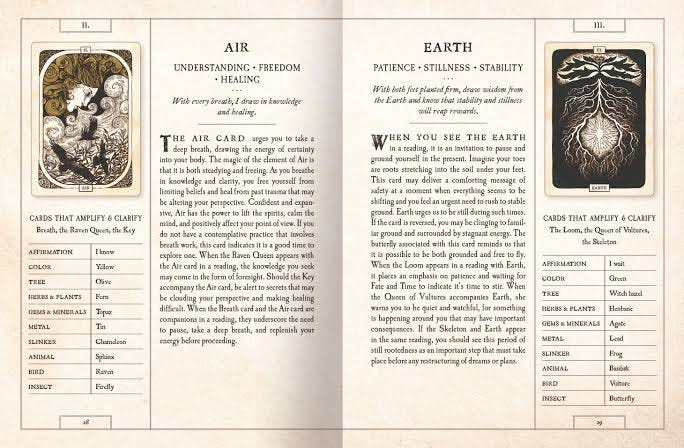
I’m not promising 52 articles. But I love the idea that there are now 52 different doors into a world we already know—and that opening one of them might make us notice something we missed the first time through.
That’s where we’re going next.
And we’re starting with The Mirror.
Your Draw
Before we begin: if you could put The Mirror in front of one All Souls character and ask them to see themselves clearly, who would you choose?