

One of the things I’ve always admired about Deborah Harkness is that she never treats objects as scenery.
Her manuscripts matter.
Her libraries matter.
Her houses matter.
Nothing in All Souls exists simply to move the plot forward. Objects have histories, previous owners, and stories of their own. Ashmole 782 isn’t memorable because it’s magical. It’s memorable because Deborah Harkness convinces us it existed long before Diana Bishop ever called it from the Bodleian stacks.
That ability to make fictional objects feel historical may be one of her greatest gifts as a writer.
Now she’s doing something she has never done before.
On August 18, The Black Bird Oracle Deck will become the first major object from the All Souls universe to cross from fiction into the real world.
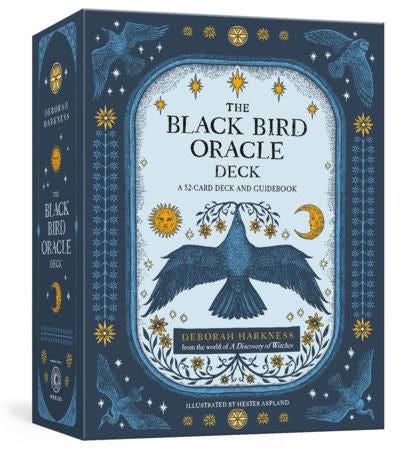
What fascinated me wasn’t simply the announcement of a deck. Although I did jump to get my pre-order in and can’t wait for it to arrive!
It was the idea that an object readers had previously encountered only in fiction would now exist beyond the pages of the novel.
That raised a different question for me.
Why an oracle?
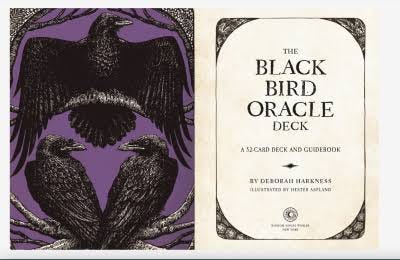
Deborah Harkness is a historian. Her novels are built on real manuscripts, real libraries, real places, and centuries of scholarship. Even the most magical moments in All Souls are grounded in historical traditions. Creating an oracle deck might seem like an unexpected departure.
I suspect it isn’t.
The more I thought about it, the more it felt like a natural extension of everything she has been writing about for nearly twenty years.
Throughout the All Souls series, Deborah Harkness has explored how knowledge survives. Sometimes it survives in manuscripts. Sometimes in libraries. Sometimes in family traditions passed quietly from one generation to the next. Again and again, she reminds us that ideas endure because someone chooses to preserve them.
An oracle deck, in its own way, asks a similar question.
Not What will happen next?
But How do symbols carry meaning across generations?

That’s a question historians ask all the time.
It’s also the question I’d like to explore over the next several weeks.
Rather than reviewing cards or discussing divination, I’d like to look at the history behind the deck. Why have humans organized knowledge through symbols for thousands of years? Why do birds, elements, moon phases, and alchemical imagery continue to appear across cultures? What makes an object feel like an heirloom? And how does Deborah Harkness make something entirely new feel as though it has existed for centuries?
Those questions feel entirely at home in Between the Stacks.
Because what has always interested me most isn’t simply the story Deborah Harkness tells. It’s the depth of historical thinking that makes her fictional world feel so convincingly real.
Perhaps that’s the greatest magic of all.
Not creating something out of nothing. But creating something so deeply rooted in history that it feels as though we simply hadn’t discovered it until now.
I hope you’ll join me!