

In The Book of Life, Diana and Matthew return to Sept-Tours, a house defined by history and the careful preservation of it.
In the chapel, hanging in the minstrels’ gallery, there is a tapestry depicting a unicorn in a garden. It is exactly the kind of object you would expect to find there, something old, intricate, and quietly symbolic.
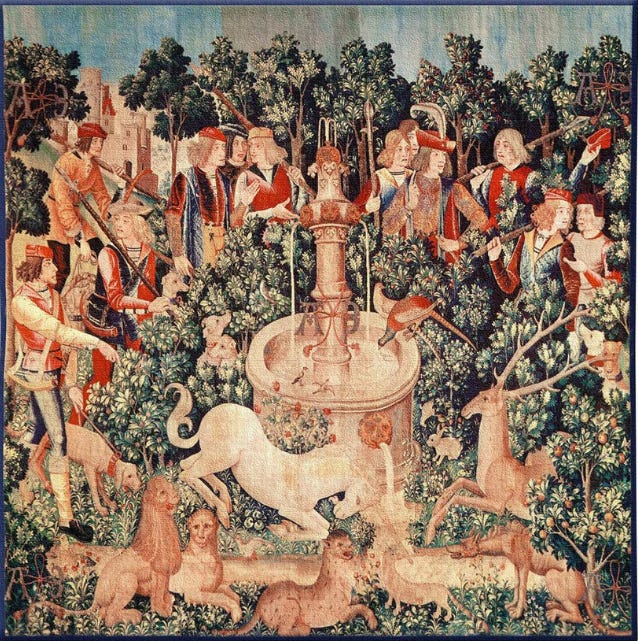
And then it’s torn.
Corra, Diana’s familiar, takes refuge in the chapel. As she is chased, she flies upward and claws through the tapestry, ripping straight through the image. What had been preserved for generations is altered in a moment.
That shift matters, because the tapestry itself carries a long artistic tradition. Works like The Unicorn Tapestries depict a unicorn enclosed within a garden, surrounded by carefully rendered plants and animals. These images are often read as symbols of purity and magic, but also of containment. The unicorn is powerful, but it is still held within a defined space.
In All Souls, that symbolism starts to feel familiar in a different way. The unicorn, so closely tied to magic, feels aligned with how witches are portrayed in the series. And when you think about the other animals that appear alongside it in these traditions, especially lions, the connection becomes clearer. Lions carry a sense of strength and control that echoes the vampire world Matthew comes from.
Daemons, as always, are harder to place. They don’t settle neatly into a symbol, which is exactly the point. They exist just outside the structure, resisting the kind of definition the tapestry seems to rely on.
That idea connects directly to the structure of the All Souls world. For much of the series, power exists within systems. The Congregation, the Covenant, and the rules that separate witches, vampires, and daemons all function to keep that power contained and understandable.
The tapestry reflects that logic. Power can exist, but it must be controlled.
What makes this moment different is that the image of control is not preserved. It is broken. Corra does not move around the tapestry or respect its boundaries. She tears through it, disrupting the very idea it represents.
This is where the scene shifts from reference to meaning. Corra represents a form of magic that does not fit within established systems. She is not governed in the same way, and by this point in the story, neither is Diana.
Diana’s magic is no longer something that can be easily categorized or contained. It is expanding beyond the structures that once defined it. The tapestry, with its enclosed and controlled image, reflects an older way of understanding power.
Corra’s action challenges that entirely.
The setting makes that disruption even more significant. This happens in the chapel at Sept-Tours, a place tied to family, continuity, and tradition. The act of tearing the tapestry suggests that what has been preserved for generations may no longer hold in the same way.
That matters for Matthew as well. His world has always been shaped by structure, hierarchy, and control. The tapestry reflects that worldview, one where power is managed and contained within clear boundaries. But Corra does not recognize those boundaries, and her presence changes the space around her.
This is where the object connects back to Diana and Matthew’s story now. They are no longer living within the old systems in the same way. They are navigating forms of power that are still evolving, in a world that has not yet caught up to what they have become.
The idea of containment no longer works as it once did.
The tapestry shows us what that world looked like. Corra shows us what it is becoming. And the question is not whether those old structures will hold, but how Diana and Matthew will respond as they begin to break. Because the rules that once defined their world are no longer enough to explain what is happening inside it.
Maybe that’s the next part of the story we explore in The Falcon and the Rose.
If you enjoy wandering deeper into the worlds behind the books we love, subscribe below.
To access the full archive of Between the Stacks essay and articles, visit our website.