

In January 2025, Deborah Harkness shared an image on Facebook to announce the title of the next All Souls novel, The Falcon and the Rose.
It’s a small detail. A hand holding a flower.
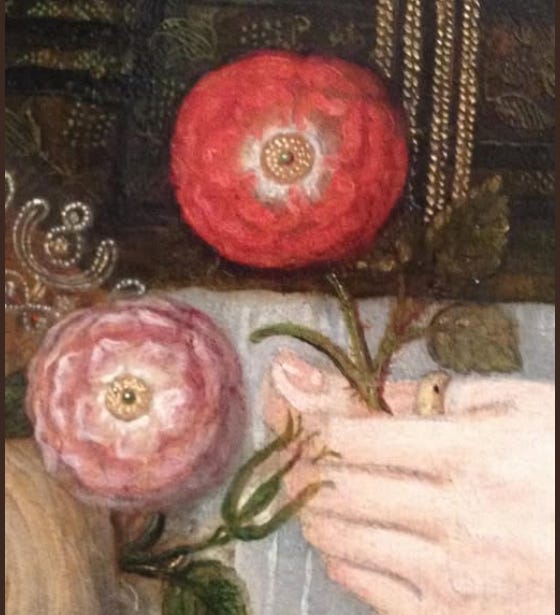
But in a series where objects carry meaning, this feels like a deliberate choice.
So what does it tell us?
First, it places us in a very specific visual world. The composition, the stylized flowers, and the controlled position of the hand all align with sixteenth-century portraiture. This is the same visual language we see when Diana and Matthew travel back to Elizabethan England in Shadow of Night.
That immediately gives us a clue about tone and timeframe. Whether or not the story returns fully to that period, the reference is clear. We are being pulled back into a world shaped by Renaissance thinking, court culture, and coded forms of communication.
Second, the flowers themselves matter.
These are not loose, naturalistic blooms. They are structured and almost emblematic. In Elizabethan imagery, flowers often functioned as symbols. A rose could signal lineage, identity, or continuity. A carnation might suggest loyalty or attachment. When flowers appear like this, they are meant to be read.
The pairing is important, but so is the way the flowers are positioned.
The red rose is held in the hand, lifted slightly forward. The paler rose is not held in the same way. It appears tucked into the fabric, part of the figure rather than something being actively presented.
That difference matters.
In sixteenth-century England, the Tudor rose combined the red rose of the House of Lancaster and the white rose of the House of York after decades of civil war known as the Wars of the Roses. When Henry VII united the two lines through marriage, the red and white rose became a single emblem of stability and a new political order.
But that symbol represents a moment after unity has already been achieved.
This image feels earlier than that.
The flowers are not fused into one form. They are not even equally held. One is chosen and brought forward into the hand. The other is already present, woven into the clothing of the figure itself.
Seen this way, the image suggests not a completed union, but something in the process of being brought together.
The hand reinforces that interpretation.
It is not gripping the stem tightly. It holds the rose with control and intention. In portraiture of this period, hands were used to communicate meaning just as clearly as facial expression. A gesture like this can suggest offering, but it can also suggest decision.
This is where the image connects most directly to the structure of the All Souls world.
Objects are rarely neutral. Manuscripts, rings, portraits, and artifacts all carry layered significance. They point backward to history and forward to consequence. They help the reader understand what is at stake before it is fully explained.
This image works in the same way.
It sets a historical frame. It establishes a tone rooted in symbolism and control. And it suggests that whatever the rose represents in this next book, it is not incidental.
It is something chosen and something carried.
And in a story shaped by Diana’s growing power and Matthew’s long memory, that distinction matters.
Because their journey is no longer about whether two worlds can come together. That has already happened.
Now they are living with the consequences of that union.
The twins are growing into their own forms of power, something neither history nor tradition has fully prepared them for.
Diana’s magic is no longer something she is simply learning to control. It is changing, expanding, becoming something new.
Seen this way, the image feels less like a symbol of unity and more like a moment of transition.
One force already present, woven into who they are.Another being actively brought forward, shaped, and chosen. Not a finished emblem, but something still forming.
So, the question is no longer whether Diana and Matthew can hold these forces together. It’s how they manage what comes next, raising children with abilities no one fully understands in a world that hasn’t caught up yet.
Maybe that’s the next part of the story we explore in The Falcon and the Rose.
If you enjoy wandering deeper into the worlds behind the books we love, subscribe below.
Next week in Places & Possessions, we’ll look at the miniature portraits of Diana and Matthew, and what it meant, in the Elizabethan world, to hold someone’s likeness in your hand and keep it close.