

In A Discovery of Witches, Diana notices a portrait hanging in Matthew’s home.
Not the main house at the manor, but the Lodge’s guest house, the more private space where Matthew lives while Amira teaches yoga to the creatures in the manor house. It is a quieter setting, slightly removed, and that makes what hangs there feel more intentional.
It’s easy to pass over the painting at first. Just another portrait in a house filled with history.
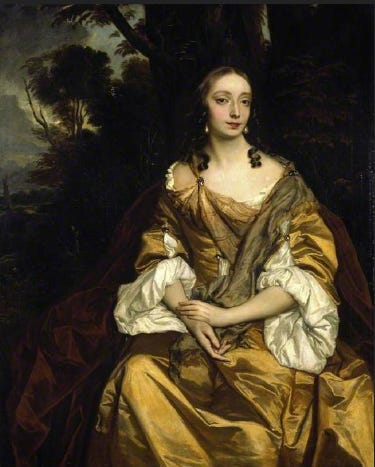
Matthew pauses long enough to explain that the woman in the potrait is Louisa de Clermont, his sister, dressed in yellow, striking and composed in a way that immediately sets her apart.
The portrait Deborah Harkness draws on reflects a specific artistic tradition. Works like Portrait of a Lady by Sir Peter Lely were designed to capture not just likeness, but presence.
The drapery, the lighting, and the pose create a sense of control, while the yellow gown draws the eye and signals visibility, confidence, and a kind of deliberate presence.
That matters in the context of Louisa’s character.
Even before she appears, we are given a version of her through this image. She is positioned within the de Clermont world, but slightly apart from it—visible, distinct, and uncontained.
Matthew tells Diana that Louisa left for Barbados to become “queen of the Indies,” and describes her as someone who absorbed every vice of every age she lived through. He also tells her how it ended. Louisa was executed by local plantation owners, beheaded and burned after becoming too dangerous to control. Her death was later hidden within the chaos of a slave rebellion, allowing those responsible to erase what had really happened.
What stands out is what Matthew does not explain.
There is no clear reason given for why Louisa was sent away, only that she was removed from the center of the family and left to create her own domain.
At this point, Diana feels sympathy for Louisa and for Matthew, who carries that history with him.
That understanding soon changes.
When Diana and Matthew travel back to 1590 in Shadow of Night, Louisa is no longer a story from the past. She is present, and the version Diana encounters is far more immediate, unpredictable, and dangerous than the portrait suggests.
Looking back, that shift changes how the painting reads.
The portrait, once a piece of history, becomes a warning she didn’t yet know how to read.
This connect to to the larger pattern in the All Souls worlds.
Objects don’t just reflect the past. They prepare you for what is coming. They introduce tension before it fully unfolds and draw your attention to what will matter later.
Louisa’s portrait does exactly that. It places her in the story early, establishes her presence before her arrival, and quietly signals that when she does intersect with Diana and Matthew’s lives, it will not be neutral.
Maybe that’s the next part of the story we explore in The Falcon and the Rose.
If you enjoy wandering deeper into the worlds behind the books we love, subscribe below.
To access the full archive of Between the Stacks essays and articles, visit our website.