

In Shadow of Night, the miniature portraits of Diana and Matthew are not just meaningful objects.
They are proof.
While Diana and Matthew are living in Elizabethan England, those they have left behind are searching for any sign that they survived their journey into the past. Ysabeau watches auction houses closely, looking for something tangible. Something that confirms they existed in that time.
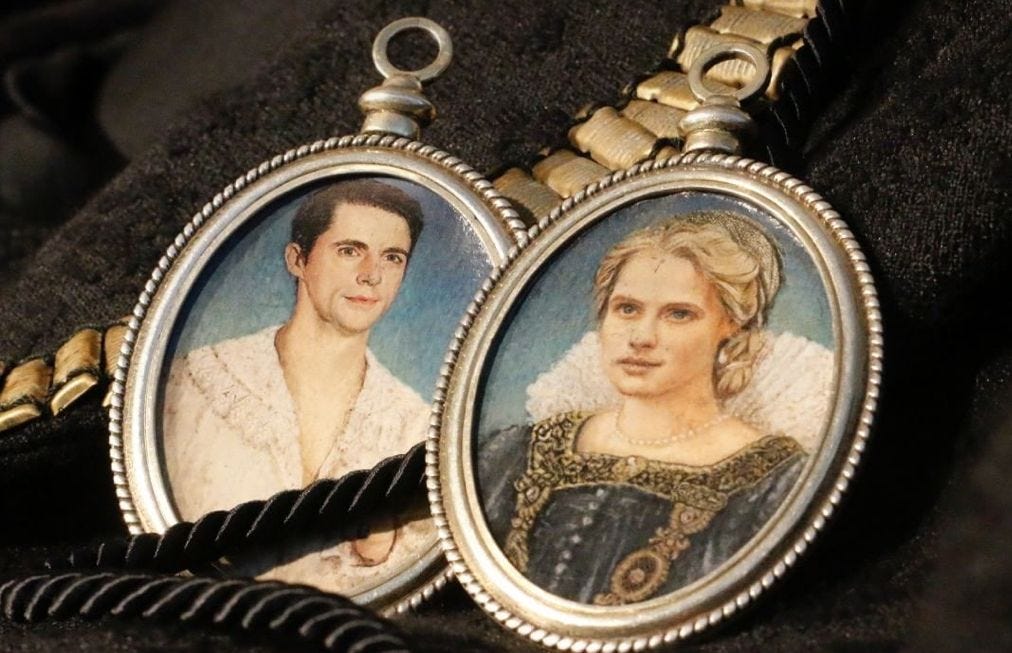
And then the miniatures appear.
Painted in the sixteenth century and attributed to Nicholas Hilliard, they show Diana and Matthew exactly where they should not exist, in the 1590s. Marcus is sent to secure them, and in doing so, the present timeline finally has confirmation.
They made it. They lived there. They left a trace.
That is what makes these objects so powerful.
Miniature portraits in the Elizabethan world were never just decorative. They were deeply personal, but they were also records. They captured not only a likeness, but a moment in time. A person’s presence. Their place within a specific world.
They could be carried, hidden, exchanged, or displayed. But they always functioned as something concrete.
Evidence that someone existed.
The connection to Diana and Matthew is exact.
These portraits do what all good objects in All Souls do. They anchor the story. They take something uncertain and make it real. Without them, the people in the present are left with theory and belief. With them, they have confirmation.
The miniatures also reflect the structure of Diana and Matthew’s relationship.
They are painted separately, two distinct images, but held together in a single object. That pairing mirrors what we see again and again in the series. Two different identities, two different histories, existing side by side without being reduced to one.
But what matters most is what they represent now.
At the time they are discovered, the miniatures answer one question. They prove that Diana and Matthew survived the past.
Now, that question has been answered, and the role of the object shifts.
It is no longer just about proof. It becomes about what is remembered, what is preserved, and what is carried forward.
Diana and Matthew are no longer trying to prove they existed. They are deciding what parts of their story will shape what comes next.
The twins will grow up knowing this history not as something discovered, but as something inherited. They are not looking for proof. They are living with the consequences of it.
Which makes the miniatures feel different.
They’re no longer just evidence of survival.
They’re a record of who Diana and Matthew were at a particular moment in time. A version of them that can be held, returned to, and remembered.
And the question now is not whether that moment happened.
It’s how much of it they choose to carry forward, raising children with abilities no one has seen before or fully understands.
If you enjoy wandering deeper into the worlds behind the books we love, subscribe below.
To access the full archive of Between the Stacks essay and articles, visit our website.