

There are some stories we never really leave.
We encounter them as children, meet them again in school, recognize them in novels, films, and paintings, and then, years later, discover they have been quietly shaping our imagination all along.
This summer, Christopher Nolan’s The Odyssey returns one of those stories to the big screen. It’s a timely reminder that Homer’s epic has never really disappeared. It has simply changed form, finding new life in every generation that chooses to tell it again.
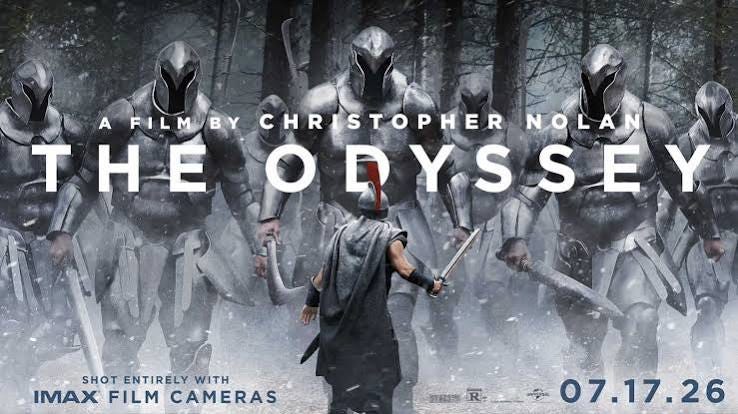
That announcement made me think less about the film itself and more about another character who has been quietly living in Homer’s world all along.
Philippe de Clermont.
Deborah Harkness tells us that Philippe was born in ancient Greece more than three thousand years ago. It’s an extraordinary piece of his story, but one that’s easy to overlook. We tend to think of it as a fascinating detail about his age rather than a clue to understanding the man himself.
What if it’s much more than that?
What if the key to understanding Philippe isn’t simply that he has lived for three millennia, but that he was shaped by the same world that produced The Odyssey?
That question became the inspiration for this summer’s series.

Over the next five Sundays, I’d like to explore Philippe through the lens of ancient Greece—not to argue that he is another Odysseus, but to ask how a man raised in the Homeric world might think about leadership, family, hospitality, legacy, and time.
We’ll look at the ancient Greek ideas that formed one of All Souls’ most compelling characters and ask how Deborah Harkness quietly wove those ideas into her novels. Along the way, we’ll discover that understanding the world Homer describes doesn’t just deepen our appreciation of The Odyssey. It changes the way we read Philippe as well.
One of the things I’ve always admired about Deborah Harkness is that she doesn’t simply tell stories set in history. She writes as a historian. Her characters are shaped by the civilizations that formed them, and nowhere is that more evident than in Philippe. His decisions, his sense of duty, and even the way he loves his family all make more sense when we remember where—and when—his story began.
My hope is that, by the end of this series, you’ll find yourself returning to Shadow of Night and The Book of Life with new eyes. Not because the story has changed, but because history has given you another way to read it.
I hope you’ll join me.We’ll follow the long conversation that stories have been having with one another for centuries.
Because perhaps no story is ever entirely new.
Every great book carries traces of the books that came before it.
Every library holds echoes.
And somewhere between Homer and Harkness is a path worth following.
I hope you’ll join me.