

One question appears again and again among readers of the All Souls trilogy.
What exactly is Ashmole 782?
Is it simply an alchemical manuscript?
Is it a book of magical allegories?
Or is it something more important - a record of the origins of witches, vampires, and daemons themselves?
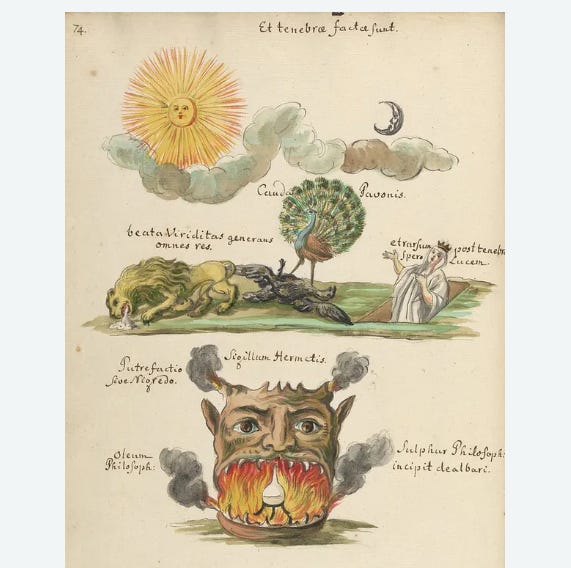
Illustration from the Thesaurus of Alchemy, ca. 1725
Within the world of Deborah Harkness’s novels, Ashmole 782 is more than a mysterious book discovered in the Bodleian Library.
It is the thread that quietly holds the entire story together.
And the moment it appears, everything begins to change.
The moment Diana Bishop calls the manuscript from the Bodleian stacks, every creature in Oxford seems to feel it.
A Moment in the Bodleian
The scene unfolds in one of the most remarkable libraries in the world.
Duke Humfrey’s Reading Room in the Bodleian Library at Oxford is a long medieval hall lined with wooden desks and towering shelves filled with manuscripts studied for centuries. Portraits of kings, queens, and scholars watch silently from the walls above the bookshelves.
It is the kind of place where history feels almost alive.
Readers sit quietly beneath the high timbered ceiling, turning pages that once passed through the hands of monks, scholars, collectors, and scientists.
Diana is there as a historian of alchemy.
She requests a manuscript — Ashmole 782 — expecting nothing more than another alchemical text for her research.
Instead, something extraordinary happens.
The pages shimmer with hidden illustrations.
Images appear that were not visible before.
And before Diana fully understands what she is seeing, the manuscript slips away again — vanishing back into the library’s vast system of stacks.
But the moment it appears, something else happens.
Creatures across Oxford feel it.
Witches.
Vampires.
Daemons.
All of them suddenly know the manuscript has surfaced again after centuries of absence.
The Many Stories About Ashmole 782
Part of what makes Ashmole 782 so fascinating is that no one seems to agree on what the manuscript actually is.
Within the world of the trilogy, the book has been surrounded by rumors for generations.
Among witches, there are whispers that the manuscript may contain the earliest traditions of spellcraft — perhaps even the first grimoire.
Among vampires, the legends are darker. Some believe the book may hold secrets about the origins of their strength and longevity.
Daemons tell yet another story. In their version, the manuscript contains something even older — a history of origins that might explain where daemons fit within the creature world.
At the beginning of the story, these explanations contradict one another.
Each group sees the manuscript through the lens of its own fears and ambitions.
And that may be the most interesting thing about Ashmole 782.
For centuries, witches, vampires, and daemons have lived under the rules of the Covenant — an agreement designed to keep the three groups separate from one another.
But the rumors surrounding this manuscript suggest something different.
That somewhere in its pages might be a story that does not belong to just one creature at all.
The Image of the Alchemical Child
One of the most striking images associated with Ashmole 782 is the alchemical child.
In historical alchemy, the child symbolized transformation — the moment when opposing forces combine to create something entirely new.
Alchemical manuscripts often depicted this moment as the union of two elements producing a child — not a literal birth, but a metaphor for renewal and possibility.
Within the story, this symbolism begins to feel less metaphorical.
Because the future of the creature world may depend on exactly that kind of union.
Diana, a powerful witch, and Matthew, an ancient vampire, come from histories that the Covenant has kept separate for centuries.
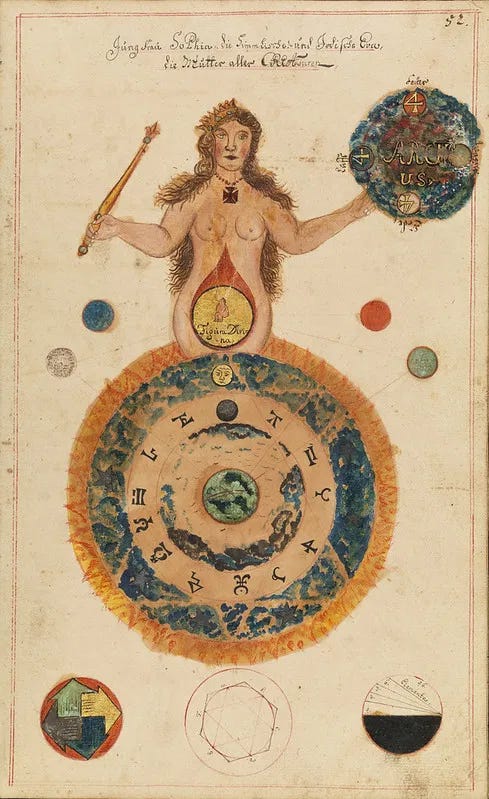
From Gemma Sapientiae et Prudentiae (18th century)
But the manuscript hints that the boundaries between witches, vampires, and daemons may never have been as fixed as everyone believed.
And eventually, Diana and Matthew will become the parents of twins.
Children who embody the transformation the alchemists once imagined.
Not a return to the past.
But the beginning of something new.
The Scholar Behind the Name
The name Ashmole comes from a real historical figure: Elias Ashmole, a seventeenth-century English scholar, collector, and antiquarian.
Ashmole lived during a time when the boundaries between science, philosophy, and magic were still fluid. Astronomy and astrology were studied side by side. Chemistry was emerging from the older traditions of alchemy.
In 1652 he published Theatrum Chemicum Britannicum, a collection of English alchemical texts that preserved centuries of earlier writings.
He was also an extraordinary collector.
Ashmole gathered manuscripts, antiquities, and historical records with remarkable dedication. His collections eventually formed the foundation of the Ashmolean Museum in Oxford, one of the oldest public museums in the world.
Without collectors like Ashmole, many of the manuscripts that inspired writers like Deborah Harkness might never have survived.
Manuscripts You Can Explore Yourself
One of the most wonderful things about modern libraries is that many of these manuscripts can now be viewed online.
If the world of A Discovery of Witches makes you curious about real historical manuscripts, here are a few places to begin exploring.
The Bodleian Library Digital Collections
The Bodleian has digitized thousands of manuscripts and rare books from its collections — including alchemical texts similar to the ones Diana studies.
Trinity College Dublin Digital Library
Trinity College holds one of the most famous manuscripts in the world: the Book of Kells, an illuminated gospel manuscript created around the ninth century. Visitors to Dublin can see it in person, but many of its pages can also be viewed online.
The Morgan Library & Museum Digital Collections
The Morgan Library in New York holds extraordinary medieval manuscripts, early scientific texts, and Renaissance notebooks.
The Voynich Manuscript (Yale Beinecke Library)
This mysterious illustrated manuscript — filled with strange plants, astronomical diagrams, and an undeciphered language — remains one of the most famous unsolved puzzles in manuscript history.
Exploring these collections is a little like stepping into the same world Diana inhabits.
Scholars turning pages.
Images revealing themselves slowly.
Centuries of knowledge waiting quietly in the stacks.
If you enjoy wandering deeper into the worlds behind the books we love, subscribe below.
Coming Friday
Next in Between the Lines:
Matthew Clairmont.
A brilliant scholar.
An ancient vampire.
And a man whose past is filled with violence.
The question readers keep returning to is a difficult one:
Can a vampire who has lived for centuries truly escape the weight of his past?